
Japan · Noodle soups
Curry udon
Thick udon in a glossy curry sauce built on dashi, with tender slices of beef or pork and plenty of spring onion. Japan's noodle-shop comfort food, made from scratch.
- Prep
- 10 min
- Cook
- 45 min
- Total
- 1 hr
- Effort
- Takes some care
- Serves
- 4
Ratings by the Soupmap Culinary Team, not readers.
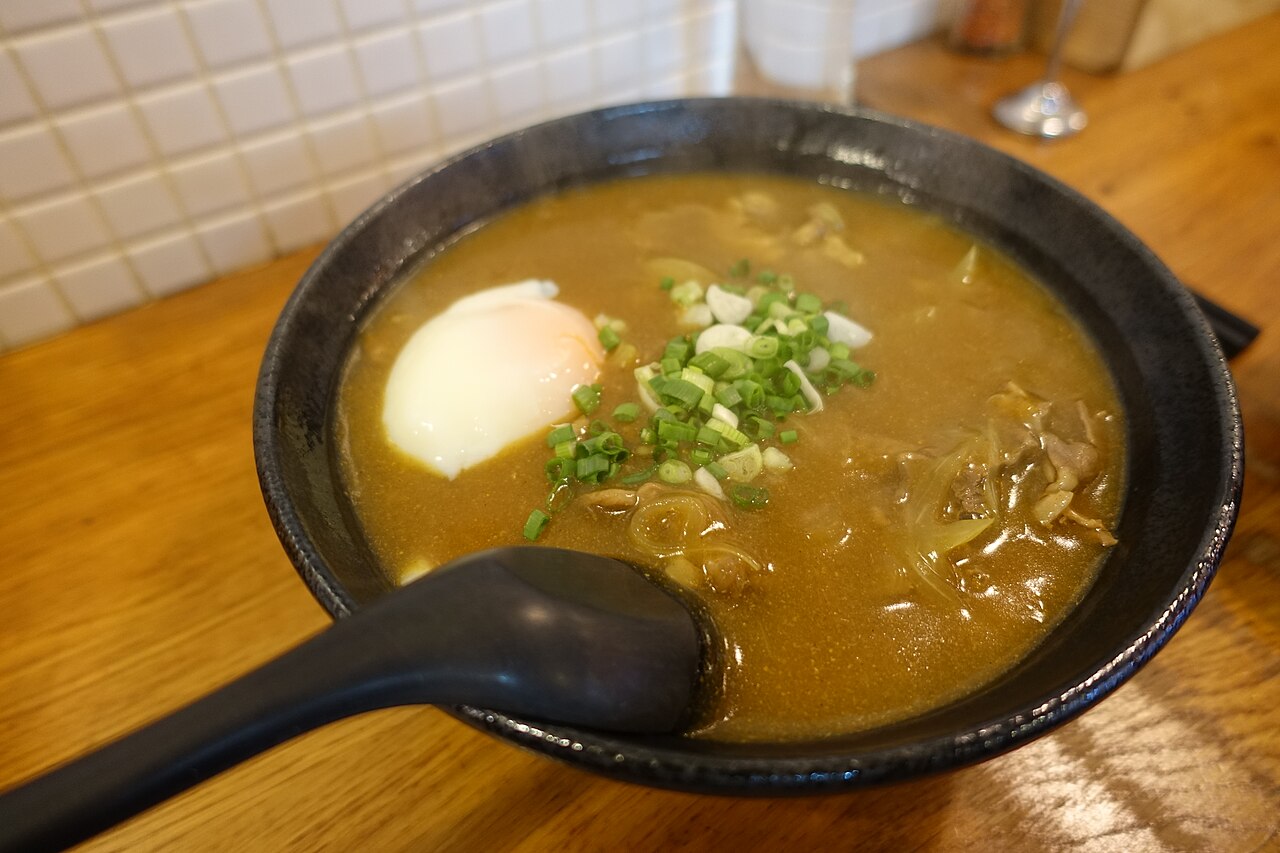
Curry udon is what happens when a noodle shop gets hold of curry. Curry reached Japan by way of Britain in the late 1800s, and stirring it into a pot of udon (thick wheat noodle) broth is usually said to have started at Tokyo noodle shops in the early 1900s. It has been on udon menus ever since.
What sets it apart from curry rice is the base. The curry is built on dashi (Japanese stock) seasoned with soy sauce and mirin (sweet rice wine), the same broth you'd pour over plain udon, so it tastes of bonito and soy as much as of spice. It's thick enough to cling to every noodle, but it's still a soup, not a stew.
Plenty of home cooks use a box of instant curry roux, and that works (see Variations). Making the roux yourself takes ten minutes and gives a cleaner, brighter curry flavour, with the salt under your control. Cook the flour in butter until it smells nutty, toast the curry powder in it for a moment, then loosen the paste with hot broth before it goes into the pot. That last step is the one people skip, and it's why curry udon so often turns out lumpy.
Ingredients
Dashi
Curry broth
Roux
To serve
Method
Tap a step's number to tick it off, and a time to start a timer.
Make the dashi
Put the water and kombu in a pot over medium-low heat. When small bubbles cling to the kombu, just before the water boils, 10–15 minutes, lift it out.
Bring the water to a boil, add the katsuobushi and turn off the heat. Leave until the flakes sink, about 3 minutes, then strain through a sieve lined with kitchen paper without pressing. You need 1.4 l.
Build the curry broth
Heat the oil in a wide, heavy pot over medium heat. Add the onion and spring onion whites and cook, stirring, until soft and translucent and just starting to colour at the edges, 5–6 minutes.
Add the meat and stir until it has just changed colour, 1–2 minutes. Pour in 1.4 l of the dashi with the soy sauce, mirin, sugar and salt, bring to a boil and skim off any grey foam. Simmer over medium-low heat until the onion is very soft and sweet, 8–10 minutes.
Make the roux and thicken
While the broth simmers, melt the butter in a small frying pan over medium-low heat. Add the flour and stir constantly until the paste loosens, bubbles, smells nutty like baking biscuits and turns pale gold, 4–5 minutes.
Turn the heat to low, add the curry powder and stir for 30 seconds, just until fragrant; it scorches and turns bitter quickly. Take the pan off the heat and leave it for 1 minute to stop sizzling.
Add a ladle of hot broth to the roux, slowly at first because it will spit, and whisk hard into a thick, smooth paste. Whisk in a second ladle until it looks like loose batter with no lumps, then scrape it all into the pot, stirring as it goes in.
Simmer over low heat, stirring often and scraping the bottom, until the curry is glossy, coats the back of a spoon and has lost any raw, floury taste, 5–8 minutes. For a thicker, noodle-shop finish, mix the potato starch with 2 tbsp cold water, stir it in and simmer for 1 minute more. Taste and add salt if it needs it, then keep warm over the lowest heat, stirring now and then so it doesn't catch.
Cook the noodles and serve
Bring a large pot of water to the boil and fill the serving bowls with hot water to warm them. Cook the udon straight from frozen until hot through, 1–1 1/2 minutes, then drain very well; water clinging to the noodles thins the curry.
Empty the bowls, divide the noodles between them and ladle about 400 ml of curry and meat over each. Scatter with the spring onion greens and serve at once, with shichimi on the table.
Swaps
Cooking for coeliac disease or an allergy? Check every label: the notes below say which ones matter.
Gluten-free
- Udon is made from wheat, so there's no gluten-free curry udon as such. Ladle the curry over thick rice noodles, or over 100% buckwheat soba labelled gluten-free (most soba contains wheat), and you have a gluten-free curry noodle soup in the spirit of the curry nanban in Variations.
- Make the curry without flour: use tamari labelled gluten-free instead of soy sauce, toast the curry powder in 30 g of the butter for 30 seconds and stir it into the broth, then thicken with 3–4 tbsp potato starch mixed with twice as much cold water, added gradually until it coats a spoon. Check that the curry powder and mirin are labelled gluten-free, and avoid boxed roux, which usually contains wheat.
Plant-based
- Make a kombu-shiitake dashi: soak the kombu with 4 dried shiitake in the water for 30 minutes, heat as in step 1, then leave the shiitake to simmer gently for 10 minutes more and skip the katsuobushi. Use the oil roux from Variations instead of butter.
- Swap the meat for strips of plain aburaage (fried tofu pouches) or thick-sliced mushrooms; the seasoned aburaage sold for kitsune udon is often made with fish-based dashi, so check the label. Most frozen udon is just wheat, water and salt, but check that too. It's still recognisably curry udon, a little lighter and sweeter.
High-protein
- Double the meat to 500 g: about 12 g more protein a bowl, on top of the roughly 20 g it has as written.
- Top each bowl with a soft-boiled egg for about 6 g more (boil it until the yolk is firm for anyone who should avoid runny eggs).
- Add a sheet of plain aburaage per bowl, cut into strips, for about 5 g more.
Tips
- Cook the roux properly, but gently. Undercooked flour tastes pasty, and scorched flour tastes burnt in a way you can't fix. Medium-low heat and constant stirring for 4–5 minutes gets you to the nutty, pale-gold stage.
- Loosen the roux before it goes in. Whisking hot broth into it a ladle at a time gives a smooth paste that disperses evenly through the pot. Dropped straight into the broth, it seizes into lumps.
- Pick the right curry powder. Japanese curry powder is mild and rounded. If you only have a hotter Indian-style blend, start with 2 tbsp and taste before adding more.
- Get the meat thin. Beef or pork sliced 2–3 mm thick stays tender in the broth. Asian grocers sell it ready-sliced for sukiyaki or shabu-shabu; otherwise freeze a piece of beef chuck or pork shoulder for 30–40 minutes until firm and slice it yourself.
- How not to wear it. Curry udon is notorious for splattering shirts. A properly thickened sauce splashes far less than a thin one, so don't cut the thickening short. At the table, lift a few noodles at a time onto a soup spoon and eat from the spoon rather than slurping hard, and tuck a napkin into your collar; some curry udon shops in Japan hand out paper bibs for exactly this reason.
Make ahead and storage
- The curry broth keeps for 3 days in the fridge; cool it quickly first. It thickens as it cools, so loosen it with a splash of water or dashi and bring it back to a full simmer, stirring, before serving.
- It freezes for up to 1 month. Leave out the potato starch if you plan to freeze it, since starch-thickened sauces tend to turn watery after freezing, and add it when you reheat.
- Leftover curry broth is very good spooned over a bowl of hot rice.
Variations
- Shortcut: boxed curry roux. Skip the butter, flour, curry powder, sugar and salt, and cut the soy sauce to 2 tbsp. When the broth has simmered in step 4, turn off the heat, stir in about 100 g Japanese curry roux, broken up, until dissolved, then simmer gently for 5 minutes, stirring. Boxed roux is salty and usually contains wheat, and many contain dairy and animal fat, so check the label.
- Curry over soba. Ladle the curry over buckwheat noodles instead. Made with plenty of leek, this is often called curry nanban and is a standard at Tokyo soba shops.
- Dairy-free. Make the roux with 4 tbsp neutral oil instead of the butter. It's just as smooth, if a little less rich.
Don't feel like cooking?
Places serving udon in Japan
From the Soupmap catalog: places listed as udon places, picked across cities. Listings, not reviews; check before you go.
- Dotonbori Imai Honten 道頓堀今井 本店 Osaka Map
- Daifuku Udon 大福うどん Fukuoka Map
- Azuma Udon あづまうどん Takamatsu, Kagawa Map
- Darumado だるま堂 Kitakyushu, Fukuoka Map
- Asahi Udon Otobashi あさひうどん 尾頭橋店 Nagoya, Aichi Map
- Kameyaserufu Udon かめやセルフうどん Okayama Map
See them on the map Udon in every city
City guidesUdon in Osaka 285Udon in Fukuoka 192Udon in Takamatsu 170Udon in Kitakyushu 142Udon in Nagoya 99Udon in Okayama 83
Your notes
Keep your cooking notes private in your account. Save what you changed and what you'd do next time.
Reviews & cooks' tips
Reviews and tips from people who've cooked this appear here.