
Japan · Noodle soups
Kake soba
Buckwheat noodles in a hot, deeply savoury broth of strong bonito dashi and a soy kaeshi left to mellow overnight. Japan's simplest soba bowl, done properly.
- Prep
- 10 min
- Cook
- 45 min
- Total
- 9 hr
- Effort
- Easy
- Serves
- 4
The total includes 8 hr 5 min of soaking, resting or chilling.
Ratings by the Soupmap Culinary Team, not readers.
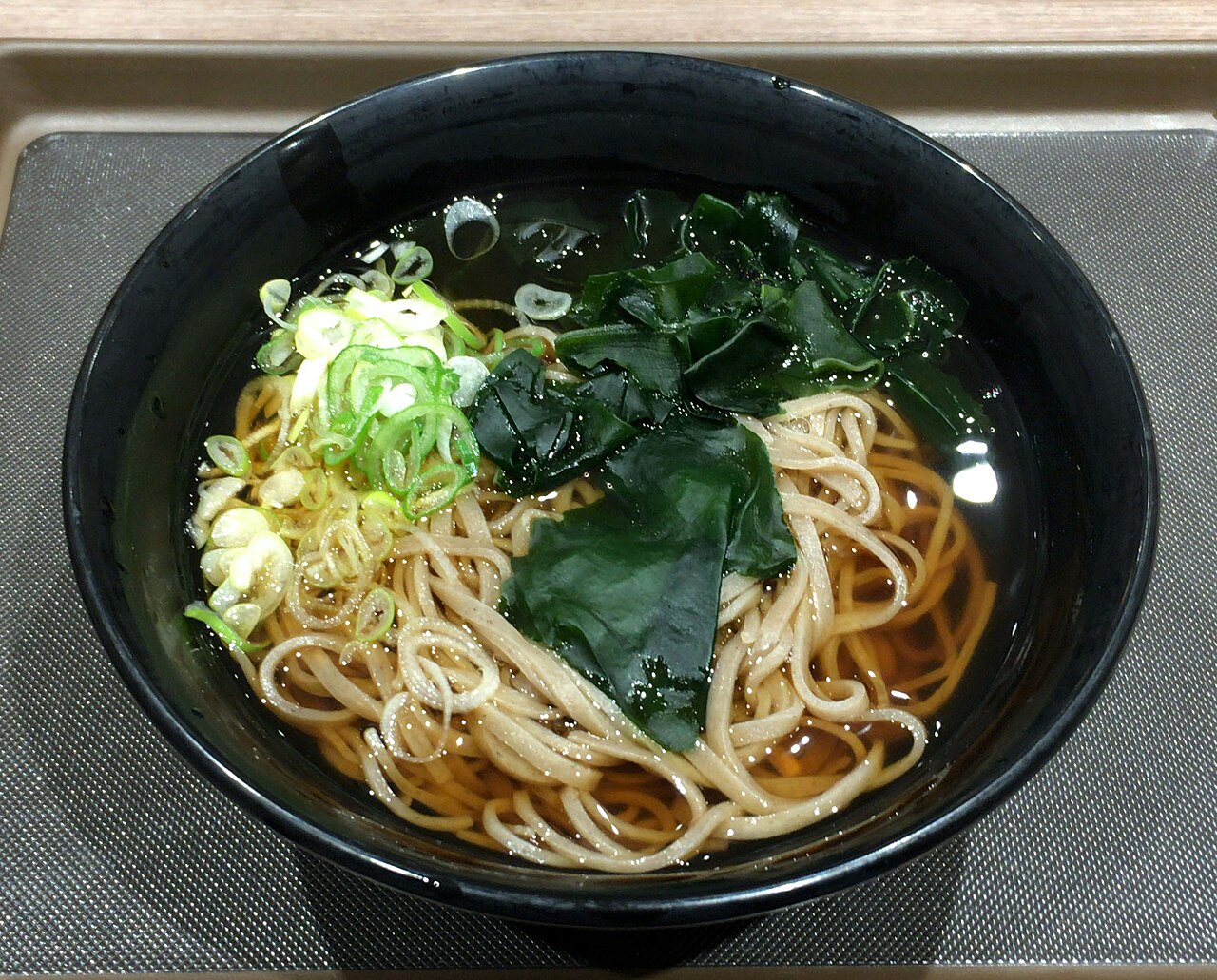
Kake means "poured over", and that's the whole idea: hot broth poured over soba (buckwheat noodles), a scattering of spring onion, perhaps a shake of chilli. With so little in the bowl there's nowhere to hide, so this recipe puts its effort into the two things that matter.
The first is the kaeshi, a concentrate of soy sauce, mirin (sweet rice wine) and sugar that soba shops warm and then leave to rest, often for a week or more. Resting softens the raw, sharp edge of the soy, and even one night makes a difference you can taste. The second is the dashi (Japanese stock), made much stronger than you'd make it for miso soup, with a generous weight of katsuobushi (dried, smoked bonito flakes) so it stands up to the dark kaeshi. Mixed at about one part kaeshi to ten parts dashi, they become the broth.
The usual mistake is with the noodles. Soba must be rinsed after cooking to wash off its starch and then dipped back into hot water. Skip the rinse and the broth turns cloudy and the noodles gluey.
This is also the bowl many households eat on New Year's Eve as toshikoshi soba, the soba that sees the old year out.
Ingredients
Kaeshi
Dashi
To serve
Method
Tap a step's number to tick it off, and a time to start a timer.
Make the kaeshi (the day before)
Pour the mirin into a small saucepan, bring it to a boil over medium heat and let it bubble for 1 minute to cook off the alcohol. Turn the heat to low, add the sugar and stir until it has completely dissolved, 1–2 minutes.
Add the soy sauce and heat gently, stirring, until it steams and small bubbles appear around the edge, about 85°C (185°F), 3–4 minutes. Don't let it boil: boiling drives off the soy's aroma and leaves it harsh. Skim off any foam and turn off the heat.
Leave to cool, then pour into a clean jar, cover and set aside in a cool, dark place for at least 8 hours, or overnight, to mellow. After that, keep it in the fridge. You'll have about 300 ml.
Make the dashi
Put the water and the kombu, if using, in a large pot over medium-low heat. When small bubbles cling to the kombu, just before the water boils, 10–15 minutes, lift it out.
Bring the water to a boil, add all the katsuobushi, then turn the heat down and keep it at a gentle simmer for 5 minutes, skimming off any foam. This is a longer simmer than you'd give a delicate clear-soup dashi, and it draws out the deeper, smokier flavour a soba broth needs.
Turn off the heat and leave for 2 minutes so the flakes settle, then strain through a sieve lined with kitchen paper or a clean cloth. Let it drip through without pressing. You need 1.45 l.
Make the broth
Pour 1.45 l of the dashi and 150 ml of the kaeshi into a saucepan, roughly 1 part kaeshi to 10 parts dashi, and heat until steaming but not boiling. Taste: it should be savoury, rounded and faintly sweet, with the bonito still clear. For a bolder, darker broth, add more kaeshi a tablespoon at a time, up to about 180 ml in total (about 1 to 8). Keep hot over low heat.
Cook the soba and serve
Fill the serving bowls with hot water to warm them. Bring at least 3 l of unsalted water to a rolling boil in a large pot.
Add the soba, stirring gently to separate the strands, and cook at a lively simmer until tender with no hard white core, usually 4–6 minutes for dried (check the packet) or 1–2 minutes for fresh. If the water foams up towards the rim, add a splash of cold water.
Lift the noodles out into a colander with a spider or tongs, leaving the pot boiling on the heat. Rinse them under cold running water, gently rubbing them between your hands, until they feel smooth rather than slimy and the water runs clear, about 1 minute.
Lower the noodles, in a large sieve, back into the boiling water for 20–30 seconds to heat them through, then shake off as much water as you can.
Empty the bowls, divide the noodles between them and pour about 400 ml of hot broth over each. Top with the kamaboko and spring onion and serve at once, with shichimi on the table; soba softens quickly in hot broth.
Swaps
Cooking for coeliac disease or an allergy? Check every label: the notes below say which ones matter.
Gluten-free
- Make the kaeshi with tamari labelled gluten-free in place of the soy sauce, and taste as you mix the broth in step 7; it's a little less aromatic. Check the mirin: true hon-mirin is made from rice, but some mirin-style seasonings have other additives.
- Use 100% buckwheat (juwari) soba labelled gluten-free, since most dried soba contains wheat. It's fragile, so cook it at a gentle boil, stir it as little as possible and rinse it with a light hand.
- Leave out the kamaboko unless it's labelled gluten-free (it can contain wheat starch), and check the shichimi.
Plant-based
- Make a kombu-shiitake dashi in place of the bonito one: soak 20 g kombu and 6 dried shiitake in 2 l cold water for at least 5 hours, warm it slowly, lift out the kombu before it boils, then strain. The kaeshi is already vegan.
- Leave out the kamaboko (it's fish) and top with the kitsune tofu from Variations, simmered in the kombu-shiitake dashi. The broth is gentler and earthier, without bonito's smoky depth: a good bowl, but not quite a soba-shop one.
High-protein
- Around 15 g protein a bowl, mostly from the noodles. For more, poach 100 g thinly sliced chicken thigh per bowl in a small pan of the broth at a gentle simmer until cooked through, 4–5 minutes, and add it to the bowl, as in kashiwa soba (chicken soba): about 18 g more.
- Or add a soft-poached egg per bowl (about 6 g; see Variations for the raw tsukimi egg and its food-safety note), or a sheet of kitsune tofu (about 5 g).
Tips
- Give the kaeshi time. One night takes the sharp, raw edge off the soy, and three days to a week in the fridge makes it rounder still. That resting is what separates a soba-shop broth from soy sauce stirred into stock.
- Make the dashi strong. A dark, soy-based broth flattens a delicate dashi, which is why this one uses about 3.5% katsuobushi to water. If you can find atsukezuri (thick-shaved bonito flakes), the cut soba shops use, use the same weight with an extra 250 ml water and simmer it for 20–30 minutes.
- Rinse, then reheat. It feels odd to cool noodles you're about to serve hot, but washing off the surface starch is the difference between clean, separate strands and a cloudy, sticky bowl.
- Never boil the finished broth. A hard boil drives off the aroma of the soy and the bonito. Keep it steaming, just below a simmer, until you pour.
- Know your buckwheat. Most dried soba contains wheat flour as well as buckwheat (check the packet), and buckwheat can cause severe allergic reactions, so ask before you serve it to guests.
Make ahead and storage
- The kaeshi keeps in a clean, sealed jar in the fridge for up to 1 month, so it's worth making a double batch.
- Leftover kaeshi makes a dipping sauce for cold soba: mix 1 part kaeshi with 3 parts cooled dashi.
- The dashi, and the finished broth, keep for 2 days in the fridge. Cook the noodles only when you're ready to eat; they don't keep.
Variations
- Shortcut: same-day kaeshi. Make the kaeshi on the day, cool it quickly in a bowl set over iced water and use it after 30 minutes. The broth will taste a little sharper; 1 tbsp extra mirin in the pot rounds it out.
- Tsukimi soba ("moon-viewing" soba). Crack a very fresh egg into the middle of each bowl just before serving; the hot broth sets the white a little and the yolk stays raw, like a moon over the noodles. Raw egg isn't advised for pregnant women, young children, older people or anyone with a weakened immune system; use pasteurised eggs wherever salmonella is a concern.
- Tanuki soba. In Tokyo, this means a bowl topped with tenkasu (crisp bits of fried tempura batter), about 2 tbsp per bowl, scattered on just before serving so they stay crunchy. A whole prawn tempura on top makes tempura soba, a popular choice on New Year's Eve.
- Kitsune soba. Top each bowl with the sweet simmered fried tofu from our kitsune udon.
Don't feel like cooking?
Places serving soba in Japan
From the Soupmap catalog: places listed as soba places, picked across cities. Listings, not reviews; check before you go.
- Ishiusu Hiki Soba Gen 石臼挽き蕎麦げん Osaka Map
- Shitan Teuchi Soba To Yakitori 紫檀手打ち蕎麦と焼鳥 Sapporo, Hokkaido Map
- Shinasobaya 支那そばや 本店 Yokohama, Kanagawa Map
- Honke Owariya Honten 本家尾張屋 本店 Kyoto Map
- Aizu Soba Niku Kappo Akasaka Sutematsu 会津蕎麦肉割烹赤坂捨松 Minato, Tokyo Map
- Ishiusu Hiki Jika Seifun Teuchi Soba Ren 石臼挽き自家製粉手打蕎麦廉 Chiyoda, Tokyo Map
See them on the map Soba in every city
City guidesSoba in Osaka 80Soba in Sapporo 59Soba in Yokohama 55Soba in Kyoto 46Soba in Minato 44Soba in Chiyoda 40
Your notes
Keep your cooking notes private in your account. Save what you changed and what you'd do next time.
Reviews & cooks' tips
Reviews and tips from people who've cooked this appear here.