
Japan · Hot pots & stews
Oden
Daikon, eggs, konnyaku, fried tofu and fish cakes, simmered slowly in a light, golden dashi until everything tastes of the pot. Japan's winter comfort, with sharp mustard.
- Prep
- 25 min
- Cook
- 2 hr 45 min
- Total
- 4 hr 20 min
- Effort
- Takes some care
- Serves
- 4
The total includes 1 hr 10 min of soaking, resting or chilling.
Ratings by the Soupmap Culinary Team, not readers.
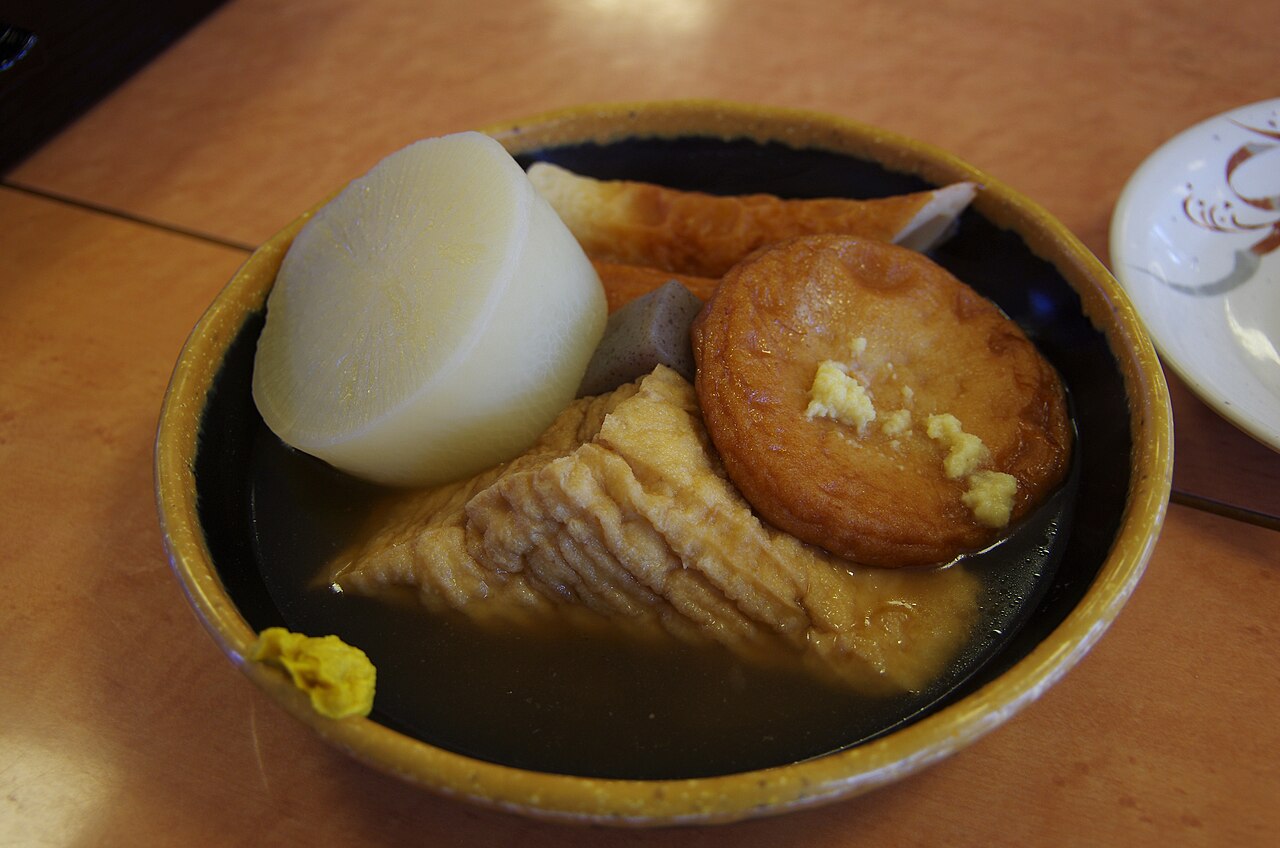
Oden is less a soup than a slow, patient pot: thick rounds of daikon (white radish), boiled eggs, konnyaku (a firm, bouncy jelly made from the konjac plant), atsuage (thick deep-fried tofu), fish cakes and little knots of kombu (dried kelp), all sitting in a barely moving dashi (kelp and bonito stock) until each piece has drunk its fill. You pick out what you like, add a dab of karashi, the sharp Japanese mustard, and go back for more.
This is a Kanto-style pot, with the fish cakes the Tokyo area loves, including fluffy hanpen. Tokyo oden broth is traditionally darker, made with regular soy sauce. I've used usukuchi, the paler (but saltier) soy sauce, with mirin (sweet rice wine) and salt, so the broth stays golden and the daikon and eggs keep their colour. The darker version is in Variations.
Two things make oden good. First, it never boils: a hard simmer clouds the broth, puffs the fish cakes up until they collapse, and breaks the daikon. Second, time. Oden takes on flavour as it cools, so let the pot rest for an hour before reheating, or make it the day before. There's more on the dish in our oden essay.
Ingredients
Broth
In the pot
To serve
Method
Tap a step's number to tick it off, and a time to start a timer.
Start the daikon and eggs
Peel the daikon thickly, about 3 mm deep, to remove the fibrous layer just under the skin, and cut it into 8 rounds about 3 cm thick. Shave a thin bevel off the top and bottom edges of each round so they don't crumble in the pot, then score a cross about 1 cm deep into one face to help the broth soak in.
Put the daikon in a pan with the rice and enough cold water to cover it well. Bring to the boil, then simmer over medium-low heat until a skewer slides in with little resistance, 25–35 minutes. Rinse the rounds in warm water to wash off the rice starch.
Meanwhile, lower the eggs into a pan of boiling water and cook for 10 minutes. Move them to a bowl of cold water, then peel.
Make the dashi
While the daikon simmers, wipe the kombu with a damp cloth and soak it in the cold water in a wide pot that holds at least 5 l for 30 minutes.
Warm the pot over low heat for 15–20 minutes. When small bubbles cling to the kombu and the surface trembles, lift the kombu out, before the water boils, and set it aside.
Bring the water just to the boil over medium heat, turn off the heat and scatter in the katsuobushi. Leave it until the flakes sink, about 3 minutes, then strain through a sieve lined with a damp paper towel into a large bowl, without pressing. Rinse the pot and pour the dashi back in; you'll have about 2 l.
Prepare everything else
Cut the softened kombu lengthways into strips about 2 cm wide. Tie tight single knots along each strip, about 8 cm apart, then cut between the knots; aim for 8 knots.
Cut the konnyaku into 4 rectangles, then each one diagonally into 2 triangles. Score both faces lightly in a criss-cross, then boil the pieces in a small pan of water for 3 minutes to remove their faintly alkaline smell, and drain.
Cut each atsuage block into 4 pieces, halve the chikuwa on the diagonal and halve any large satsuma-age. Put all these fried pieces in a colander and pour a kettle of boiling water over them to rinse off the surface oil. Cut the hanpen into 4 triangles and set it aside separately.
Simmer and rest
Stir the usukuchi soy sauce, mirin and salt into the dashi and bring it up to a bare simmer over medium heat. Add the daikon, eggs, konnyaku and kombu knots, then turn the heat to the lowest setting that keeps the surface just trembling, with a bubble breaking now and then. Partly cover and cook for 1 hour; don't let it boil.
Add the atsuage, chikuwa and satsuma-age, nudging them under the broth, and cook at the same gentle heat for 30 minutes more.
Turn off the heat, cover the pot and leave it to rest for 1 hour. As it cools, the broth soaks into the daikon and eggs, which slowly turn a deeper gold.
To serve, reheat the pot over low heat until everything is steaming hot right through, 10–15 minutes, adding the hanpen for the last 5 minutes; it puffs up and turns tender, and deflates if cooked longer. Taste the broth and add salt if it needs it. Bring the pot to the table and serve a few pieces at a time in bowls with a ladle of broth, with karashi on the side.
Swaps
Cooking for coeliac disease or an allergy? Check every label: the notes below say which ones matter.
Gluten-free
- Use tamari labelled gluten-free in place of the usukuchi: 3 tbsp, plus an extra 1/2 tsp salt, tasting at the end. The broth will be darker, closer to the Tokyo style in Variations.
- Fish cakes are the hard part. Many chikuwa, satsuma-age and hanpen contain wheat starch or flour, and often soy sauce, so use only ones labelled gluten-free, or leave them out and add more daikon, eggs, atsuage and potatoes; the broth will be lighter and less savoury. Skip chikuwabu, which is wheat dough.
- Check the konnyaku, atsuage, mirin and karashi labels too.
Plant-based
- Make the broth with kombu and shiitake. Keep the 25 g kombu, replace the katsuobushi with 8 dried shiitake (about 25 g), and soak both in the cold water in the fridge for at least 5 hours. Warm slowly, lift out the kombu before it boils, simmer the shiitake for 5 minutes, then strain and add them to the pot.
- Leave out the eggs and fish cakes and fill the pot with more atsuage and daikon, the mochi pouches and potatoes from Variations, and ganmodoki (fried tofu fritters; check the label, as some contain egg). It's a gentler vegetable oden, honestly a different pot, but a good one.
High-protein
- Boil 10 eggs instead of 6, so everyone gets 2–3: about 6 g protein for each extra egg.
- Double the atsuage to 600 g: about 8 g more per bowl.
- Add 200 g more fish cakes with the others: about 6 g more per bowl.
Tips
- Never let it boil. Keep the broth at a lazy shiver. Boiling clouds the dashi, makes fish cakes swell and then go spongy and tasteless, toughens the eggs and breaks up the daikon.
- Give the daikon a head start. Pre-simmering with a spoonful of rice takes away its sharp, radishy edge and softens it so it can absorb the broth. The bevelled edges and the scored cross are small things that make a real difference.
- Rinse the oil off anything fried. Pouring boiling water over atsuage and fried fish cakes removes stale surface oil, so the broth stays clean-tasting instead of greasy.
- Add things in order. Daikon, eggs, konnyaku and kombu need the longest; fried tofu and fish cakes need about 30 minutes; hanpen needs 5.
- Shopping and substitutes: Japanese grocers sell fish cakes chilled or frozen, often as oden assortment packs. Korean fish cakes (eomuk) from Korean grocers are a good stand-in for satsuma-age and chikuwa. Nothing really matches hanpen's marshmallow-soft texture, so if you can't find it, leave it out and add more of the other fish cakes. For karashi, hot English mustard is the closest substitute.
Make ahead and storage
- Oden is even better the next day. Cool it within 2 hours (spread it between a couple of containers so it cools quickly), cover and refrigerate for up to 2 days. Reheat gently until piping hot all the way through. Don't leave the pot sitting on the stove overnight.
- If you're making it a day ahead, you can add the fish cakes when you reheat, simmering them for 30 minutes, so they stay plumper. Add the hanpen only at the end, as before.
- Don't freeze oden: the konnyaku, tofu and eggs turn spongy and rubbery.
Variations
- Darker Tokyo-style broth: replace half or all of the usukuchi with regular dark soy sauce. Dark soy is slightly less salty, so taste at the end and add a pinch more salt if needed.
- More Tokyo favourites: chikuwabu, a chewy tube of wheat dough that looks like chikuwa but contains no fish. Add it with the daikon so it has time to turn soft and bouncy.
- Potatoes: peel small waxy potatoes, boil until just tender, and add them with the fish cakes; they crumble if they simmer for too long.
- Mochi pouches (mochi kinchaku): stuff halved aburaage (thin fried tofu pouches) with a small piece of mochi (pounded rice cake) each, close with a toothpick, and add with the fish cakes. Cut the mochi small, remove the toothpicks before serving, and eat carefully, since mochi is a choking hazard.
Don't feel like cooking?
Places serving oden in Japan
From the Soupmap catalog: places listed as oden places, picked across cities. Listings, not reviews; check before you go.
- Takoume Honten たこ梅 本店 Osaka Map
- Kushiyaki Oden Ne 串焼 おでん 根 Sapporo, Hokkaido Map
- Kanazawa Oden Tobanzai Sakaba Sansan 金沢おでんとおばんざい酒場 さんさん Kanazawa, Ishikawa Map
- Minna no Oden みんなのおでん Nagoya, Aichi Map
- Choi Oden Kodenma Machi ちょいおでん 小伝馬町店 Chuo, Tokyo Map
- Kushi Age to Oden Komurotetsuya 串揚げとおでん コムロテツヤ Kyoto Map
See them on the map Oden in every city
City guidesOden in Osaka 72Oden in Sapporo 20Oden in Kanazawa 17Oden in Nagoya 17Oden in Chuo 14Oden in Kyoto 13
Your notes
Keep your cooking notes private in your account. Save what you changed and what you'd do next time.
Reviews & cooks' tips
Reviews and tips from people who've cooked this appear here.