
South Korea · Hot pots & stews
Doenjang jjigae (soybean paste stew)
Korea's everyday stew: earthy fermented soybean paste in a quick anchovy-kelp stock, with potato, courgette, tofu and green chilli, brought to the table bubbling.
- Prep
- 10 min
- Cook
- 35 min
- Total
- 45 min
- Effort
- Easy
- Serves
- 4
Ratings by the Soupmap Culinary Team, not readers.
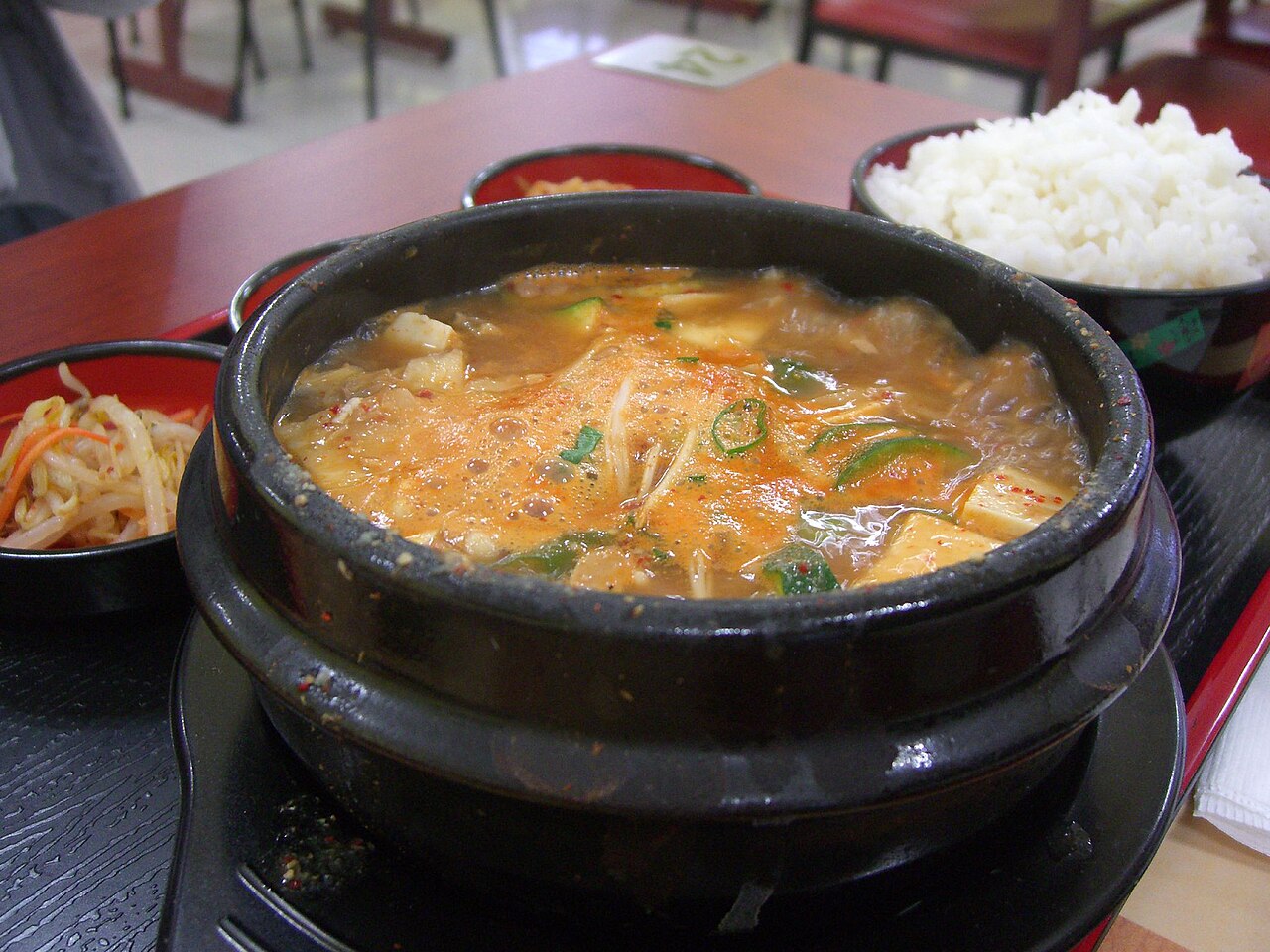
Doenjang jjigae is one of the most everyday dishes in Korean home cooking: a small, strongly seasoned stew set in the middle of the table and eaten with rice. Doenjang is Korean fermented soybean paste, chunkier and funkier than most Japanese miso, and a jjigae is a stew, thicker and saltier than a soup, usually brought to the table still boiling in the pot it was cooked in.
Its backbone is myeolchi yuksu, a stock (yuksu) of dried anchovies (myeolchi) and kelp that takes 20 minutes and gives the paste something savoury to stand on. Potato and onion go in first, courgette next and tofu last, so everything is tender at the same moment.
If you know miso soup, the one thing to unlearn is the rule about not boiling. Miso goes in at the end to protect its aroma; doenjang is meant to bubble away with the vegetables, and the stew grows rounder and deeper as it does. Do taste before adding the full amount, though, because doenjang varies enormously in saltiness from one tub to the next.
Ingredients
Anchovy-kelp stock
Stew
Method
Tap a step's number to tick it off, and a time to start a timer.
Make the stock
Put the anchovies in a dry pot over medium heat and toast them for 1–2 minutes, stirring, until they smell toasty rather than fishy.
Add the water and kelp and bring to a boil over medium-high heat. Turn the heat down to a lively simmer, take out the kelp after 5 minutes, and simmer the anchovies for 10 minutes more. Strain; you should have about 850 ml.
Make the stew
Pour 800 ml of the stock into a wide pot or a large ttukbaegi (a Korean earthenware pot) and bring it to a boil. Press about three-quarters of the doenjang and the gochujang through a small sieve into the stock with a spoon, or simply stir until dissolved.
Add the potato and onion and boil over medium heat for 6–7 minutes, until the potato is just softening at the edges.
Add the courgette, garlic and gochugaru and boil for 4 minutes, until the courgette is bright and starting to turn translucent.
Add the tofu and chillies and simmer for 3 minutes more, until the tofu is hot through and a knife slides easily into the potato. Taste: the broth should be savoury and salty enough to eat with plain rice. Stir in more doenjang, or a pinch of salt, if it needs it.
Scatter over the spring onions and carry the pot to the table while it is still bubbling. Serve with rice and any banchan (small side dishes) you have, and let everyone spoon from the pot.
Swaps
Cooking for coeliac disease or an allergy? Check every label: the notes below say which ones matter.
Gluten-free
- Many doenjang and gochujang brands contain wheat. Choose a doenjang labelled gluten-free and either leave out the gochujang or use one labelled gluten-free; the anchovies, kelp, gochugaru, tofu and vegetables are fine as they are.
- Check the banchan you serve alongside too, since many are seasoned with soy sauce.
Plant-based
- Use the vegetarian stock from Variations (kelp and 4 dried shiitake, simmered for 20 minutes), which is also vegan, and add the oyster or shiitake mushrooms to bring back some savouriness. It's lighter, but still unmistakably doenjang jjigae.
- Check the doenjang label, as some ready-seasoned stew pastes include anchovy or other seafood, and remember that kimchi and other banchan are often made with fish sauce or salted shrimp.
High-protein
- Double the tofu to 600 g (firm holds up best): about 6–10 g more protein a bowl, depending on the tofu, on top of the roughly 10 g it has as written.
- Follow the meat variation with 300 g thinly sliced beef brisket: about 14 g more a bowl.
- Add 200 g peeled raw prawns with the tofu and simmer until pink and opaque: about 10 g more a bowl.
Tips
- Clean the anchovies. Pull off the heads and split the bodies to remove the dark gut: both make the stock bitter. Toasting them briefly drives off the fishy edge.
- Don't boil the kelp for long. 5 minutes is plenty. Longer and it turns the stock slimy and bitter.
- Hold back some doenjang. Homemade jip-doenjang can be far saltier and stronger than shop-bought paste, and brands vary too. Adding three-quarters first and the rest after tasting saves the pot.
- Try rice-rinsing water. Korean cooks often make this stew with ssal-tteumul, the cloudy water from the second rinse of rice. Use it for half the water in the stock: its starch gives the stew a little body and softens the paste's edges.
- Substitutes: Japanese niboshi (small dried fish, usually anchovies) work in place of Korean stock anchovies, and Japanese kombu is the same kelp. Without doenjang, a dark, long-aged Japanese miso is the nearest stand-in, though milder and less funky.
- Gluten: many doenjang and gochujang brands contain wheat. For a gluten-free pot, choose a doenjang labelled gluten-free and leave out the gochujang.
Make ahead and storage
- Make the stock up to 3 days ahead; cool it quickly and keep it in the fridge.
- The stew is best eaten straight away. Leftovers keep for 2 days in the fridge (the potato and tofu soften); bring them back to a full boil before serving.
Variations
- With clams: add 300 g small clams, scrubbed and purged in salted water, with the courgette, and boil until they open, 3–5 minutes. Discard any that stay shut.
- With meat: fry 150 g thinly sliced pork belly or beef brisket in the pot until no longer pink, then add the stock and carry on.
- Mushrooms: add 100 g oyster or shiitake mushrooms, torn or sliced, with the courgette.
- Vegetarian: make the stock with the kelp and 4 dried shiitake instead of anchovies, simmered for 20 minutes.
Your notes
Keep your cooking notes private in your account. Save what you changed and what you'd do next time.
Reviews & cooks' tips
Reviews and tips from people who've cooked this appear here.