
Japan · Noodle soups
Tonkotsu ramen
Hakata-style pork-bone ramen: trotters and bones boiled hard for up to 12 hours into a creamy, ivory broth, with thin noodles cooked firm and the classic toppings.
- Prep
- 30 min
- Cook
- 13 hr
- Total
- 13 hr 45 min
- Effort
- A project
- Serves
- 4
The total includes 15 min of soaking, resting or chilling.
Ratings by the Soupmap Culinary Team, not readers.
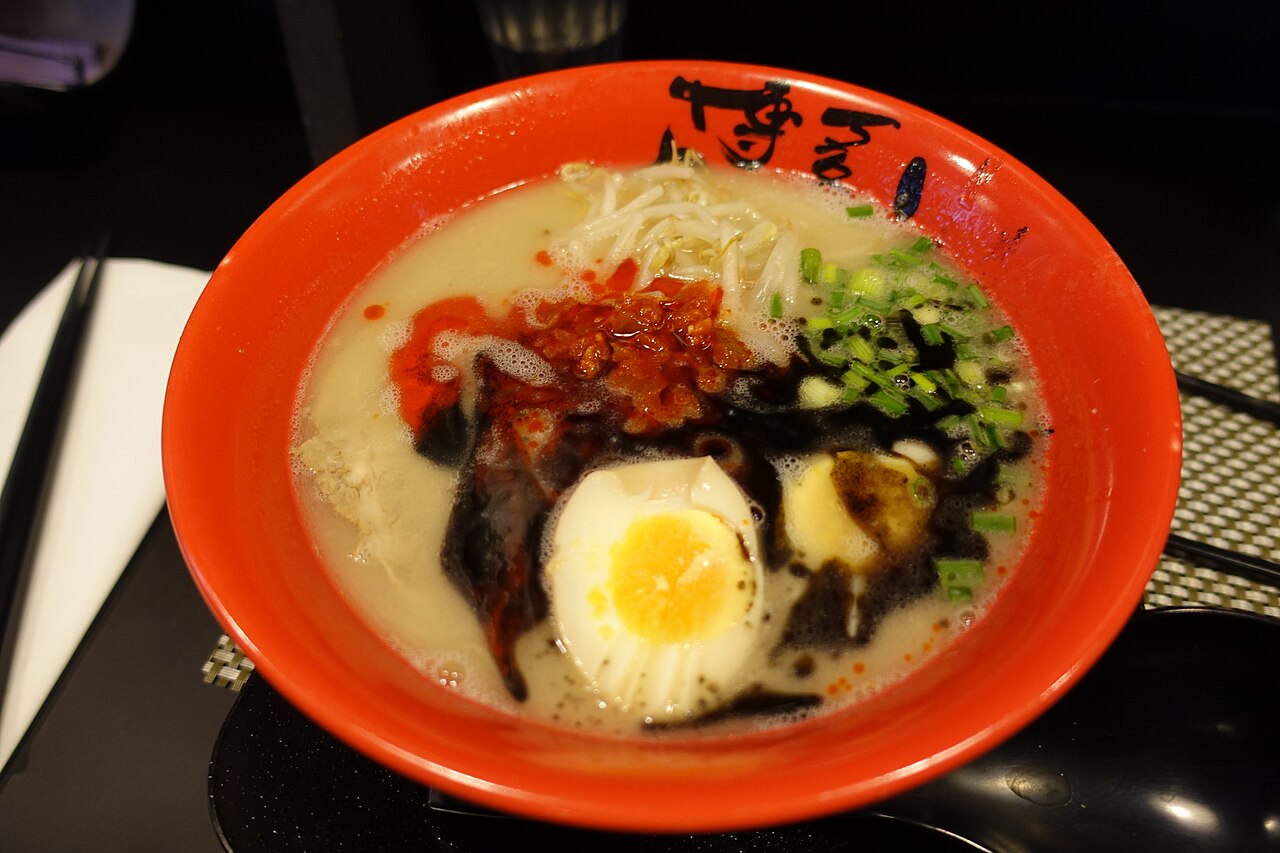
Hakata ramen, from the old merchant heart of Fukuoka, is the benchmark tonkotsu (pork-bone) bowl: an opaque, ivory broth that coats your lips, over noodles so thin they cook in under a minute. The milkiness isn't dairy or a thickener. It's collagen, marrow and fat, broken down and churned into the water by a hard rolling boil kept up for hours, until they hold together as an emulsion.
So, honestly, here is what it takes. You'll be home for about 14 hours, tending a pot that needs topping up with boiling water every hour or so; counting the blanch, around 15 l of water will pass through it. The kitchen will smell powerfully of pork bones, farmyard-ish at first and mellowing as the broth turns creamy, and the smell lingers in curtains and coats. Open the windows and close the doors to the rest of the house.
The mistake people make is turning the heat down. A polite simmer gives you a clear pork stock, which is lovely but isn't tonkotsu. It has to roll.
Ingredients
Broth
Chashu
Shio tare
Kikurage
To serve
Method
Tap a step's number to tick it off, and a time to start a timer.
Blanch and scrub the bones
Put the trotters and bones in a pot of at least 10 l, cover with cold water and bring to a boil over high heat. Boil hard for 10 minutes, until a thick grey-brown scum covers the surface.
Drain in the sink and rinse each piece under cold running water. Scrub away the dark clotted blood with a brush or chopstick, especially inside the cracked femurs and around the trotter joints. Scrub the pot clean too: any scum left on the sides will grey the broth.
Boil for 10–12 hours
Return the bones to the clean pot with about 5 l cold water, enough to cover them by a few centimetres. Bring to a boil over high heat, skimming off the foam for the first 20–30 minutes. After that, stop skimming: the fat floating now is part of what makes the broth creamy.
Keep the pot at a hard, rolling boil, the whole surface churning, with the lid ajar to slow evaporation. Keep a full kettle beside it. Every hour or so, top up with boiling water to keep the bones just covered, and scrape the bottom with a sturdy wooden spatula so nothing sticks and scorches.
After about 3 hours the broth will be beige and cloudy, and by 5–6 hours the trotters will be soft and collapsing. From then on, each time you top up, mash the trotters and bones against the side of the pot with the spatula or a potato masher to break them down and release more marrow and collagen.
With 2 hours to go, add the ginger and leek greens. For the last hour, stop topping up so the broth reduces and concentrates.
Cook the chashu (about 4 hours before the end)
Tie the pork belly into a neat block with butcher's twine and lower it into the boiling broth. Boil for 2 hours, until a skewer slides in easily.
Meanwhile, bring the soy sauce, mirin, sake and sugar to a boil in a small pan, bubble for 1 minute and pour into a container just big enough to hold the pork. Lift the cooked pork into the warm marinade and leave it for at least 1 hour, turning it every 20 minutes. If you won't eat within 2 hours, refrigerate it in the marinade once cool.
Make the tare and the kikurage (while the broth boils)
For the tare, soak the kombu in the water and sake in a small pan for 30 minutes. Heat slowly over low heat until small bubbles appear at the edge, about 10 minutes, then lift out the kombu. Add the mirin and simmer for 1 minute. Turn off the heat, add the katsuobushi and steep for 5 minutes, then strain, pressing lightly. Stir in the salt until completely dissolved. You should have about 200 ml.
Soak the kikurage in plenty of warm water until soft and swollen, 20–30 minutes. Trim off any hard knobs, slice into thin strips, then blanch for 1 minute in boiling water. Drain and toss with the soy sauce and sesame oil.
Finish the broth
After 10–12 hours the broth should be opaque, ivory-white and thick enough to coat the back of a spoon, with the bones breaking apart. Strain it through a fine sieve into a clean pot, pressing hard on the solids and pushing the soft trotter through for extra body.
Measure it: you need 350 ml per bowl, and you'll probably have about 2 l. If it tastes thin or you have far more, boil it hard to reduce; if it's very thick, whisk in a little boiling water. Whisk it hard, or blitz it with a stick blender for 30 seconds, until smooth and creamy.
Assemble
Bring a large pot of unsalted water to a rolling boil and fill the bowls with hot water to warm them. Keep the broth at a gentle boil; unlike a clear broth, tonkotsu is happy bubbling, which keeps it emulsified. Slice the chashu thinly, about 3 mm.
Empty the bowls, put 35 ml (2 tbsp plus 1 tsp) tare in each, then ladle in 350 ml boiling broth and whisk briefly.
Cook the noodles two portions at a time. For kata (firm), boil for about 30 seconds less than the packet says, usually 40–60 seconds for fresh Hakata-style noodles; a strand should be cooked through with a slightly firm core. Drain well, shaking hard.
Drop the noodles into the soup and top with chashu, kikurage, spring onions and sesame seeds, crushing the seeds between your fingers as you scatter them. Serve at once, with beni shoga on the table.
For kaedama, cook about 60 g of extra noodles the same way when someone is nearly out of noodles but still has soup, and drop them straight into the bowl. Add 1 tsp tare if the soup now tastes thin.
Swaps
Cooking for coeliac disease or an allergy? Check every label: the notes below say which ones matter.
Gluten-free
- The noodles are wheat, and they're half the dish. Use thin, straight noodles labelled gluten-free (usually rice or millet) and cook them just to tender. They won't have the firm, springy bite that kansui (alkaline salts) gives ramen noodles, so think of it as a gluten-free tonkotsu bowl rather than true Hakata ramen, and use the same noodles for kaedama.
- Make the chashu marinade and dress the kikurage with tamari labelled gluten-free instead of soy sauce. The broth and shio tare have no gluten ingredients, but check the labels on the mirin and beni shoga.
Plant-based
- There's no plant-based tonkotsu: the dish is pork bone by definition. The closest bowl in spirit is a creamy soy milk ramen, with the shio tare made without katsuobushi.
- For its broth, soak 10 g kombu and 4 dried shiitake in 1 l cold water for at least 1 hour, heat slowly to just below a simmer and strain. For each bowl, heat 175 ml of it with 175 ml unsweetened soy milk and 1 tbsp white sesame paste until steaming, without letting it boil, so the soy milk doesn't split.
- Top it with fried tofu instead of chashu; the kikurage, spring onions, sesame and beni shoga are already plant-based. Check the noodle label, as some ramen noodles contain egg.
High-protein
- Add a soft-boiled or marinated egg to each bowl (the ajitama from the shoyu ramen are ideal): about 6 g protein each.
- Cook a second 500 g block of pork belly alongside the first, doubling the marinade, and add about 50 g extra chashu to each bowl: about 8 g more. Pork shoulder, cooked the same way, gives leaner slices with more protein in each.
Tips
- Keep it rolling, and top up with boiling water. Agitation is what emulsifies the fat into the broth. If the surface is merely trembling, turn the heat up. Cold water knocks the pot off the boil, so always add water from the kettle.
- Scrape the bottom. As the broth thickens, bone fragments and collagen settle and catch easily, and a scorched broth tastes burnt all the way through, with no fix. A heavy-based pot helps; scrape every hour, and more often towards the end.
- Never leave it unattended. Don't keep a pot at a rolling boil while you're out or asleep. If you need to split the cooking over two days, cool the pot quickly in a sink of iced water (or ladle it into smaller containers), refrigerate the liquid and bones within 2 hours, and bring it back to a hard boil the next morning before carrying on.
- Soak the bones first if you can. A few hours in cold water in the fridge, or overnight, changing the water once or twice, draws out more blood, which means a whiter broth and a cleaner smell.
- Find the right noodles. Hakata noodles are very thin, straight and made with little water, so they cook in seconds and stay firm. Japanese and East Asian grocers often sell them fresh, frozen or dried; otherwise use the thinnest straight ramen noodles you can find, and cook them firm.
Make ahead and storage
- The broth sets to a firm jelly in the fridge, which is a good sign. It keeps for 3 days, or 3 months frozen in portions. Reheat it to a rolling boil and whisk hard, or blitz with a stick blender, to bring the emulsion back together.
- The tare keeps for a month in a sealed jar in the fridge.
- The chashu keeps in its marinade in the fridge for 4 days, and slices more thinly when cold.
- The kikurage keeps for 3 days in the fridge.
Variations
- Mayu (black garlic oil): It's more closely tied to Kumamoto ramen than to Hakata, but it's a popular add-on. Cook 8 finely chopped garlic cloves in 60 ml neutral oil over medium-low heat, stirring constantly, as the garlic turns golden, then brown, then black, 15–20 minutes. Take off the heat and leave to cool, then add 2 tbsp sesame oil and blend until smooth. It should taste roasted and bittersweet, not acrid; drizzle about 1 tsp over each bowl. Run the extractor fan, because blackening garlic is smoky.
- Shoyu tare: For a darker, rounder bowl, swap the shio tare for the soy tare from the shoyu ramen, about 35 ml per bowl.
- At the table: Set out karashi takana (spicy pickled mustard greens) and fresh garlic with a press, as Hakata shops often do, and add them a little at a time.
Don't feel like cooking?
Places serving tonkotsu ramen in Japan
From the Soupmap catalog: places whose names point to the style, picked across cities. Listings, not reviews; check before you go.
- Ganso Hakata Ramen Kachi Fuku 元祖博多らーめん 勝福 Fukuoka · where the style comes from Map
- Hakata Ramen Waga Ba Itsukaichi 博多らーめん我馬五日市店 Hiroshima Map
- Hakata Nagahama Ramen Nanba Kaede Shin 博多長浜らーめん 難波楓神 Osaka Map
- Hakata Ramen Shinjitsu 博多らーめん 真実 Himeji, Hyogo Map
- Hakata Ramen Honmarutei Atsuta 博多ラーメン 本丸亭熱田店 Nagoya, Aichi Map
- Hakata Ikkousha Hakata Yatai Ramen 博多屋台ラーメン 一幸舎 Chiyoda, Tokyo Map
See them on the map Tonkotsu ramen in every city
City guidesHakata ramen in Fukuoka 122Hakata ramen in Hiroshima 18Hakata ramen in Osaka 13Hakata ramen in Himeji 11Hakata ramen in Nagoya 11Hakata ramen in Chiyoda 8
Your notes
Keep your cooking notes private in your account. Save what you changed and what you'd do next time.
Reviews & cooks' tips
Reviews and tips from people who've cooked this appear here.