
Japan · Noodle soups
Shoyu ramen
A clear chicken-and-dashi broth, a sharp soy tare, rolled braised pork belly and jammy marinated eggs. Tokyo's classic bowl, done properly at home.
- Prep
- 30 min
- Cook
- 4 hr 25 min
- Total
- 5 hr 15 min
- Effort
- A project
- Serves
- 4
The total includes 20 min of soaking, resting or chilling.
Ratings by the Soupmap Culinary Team, not readers.
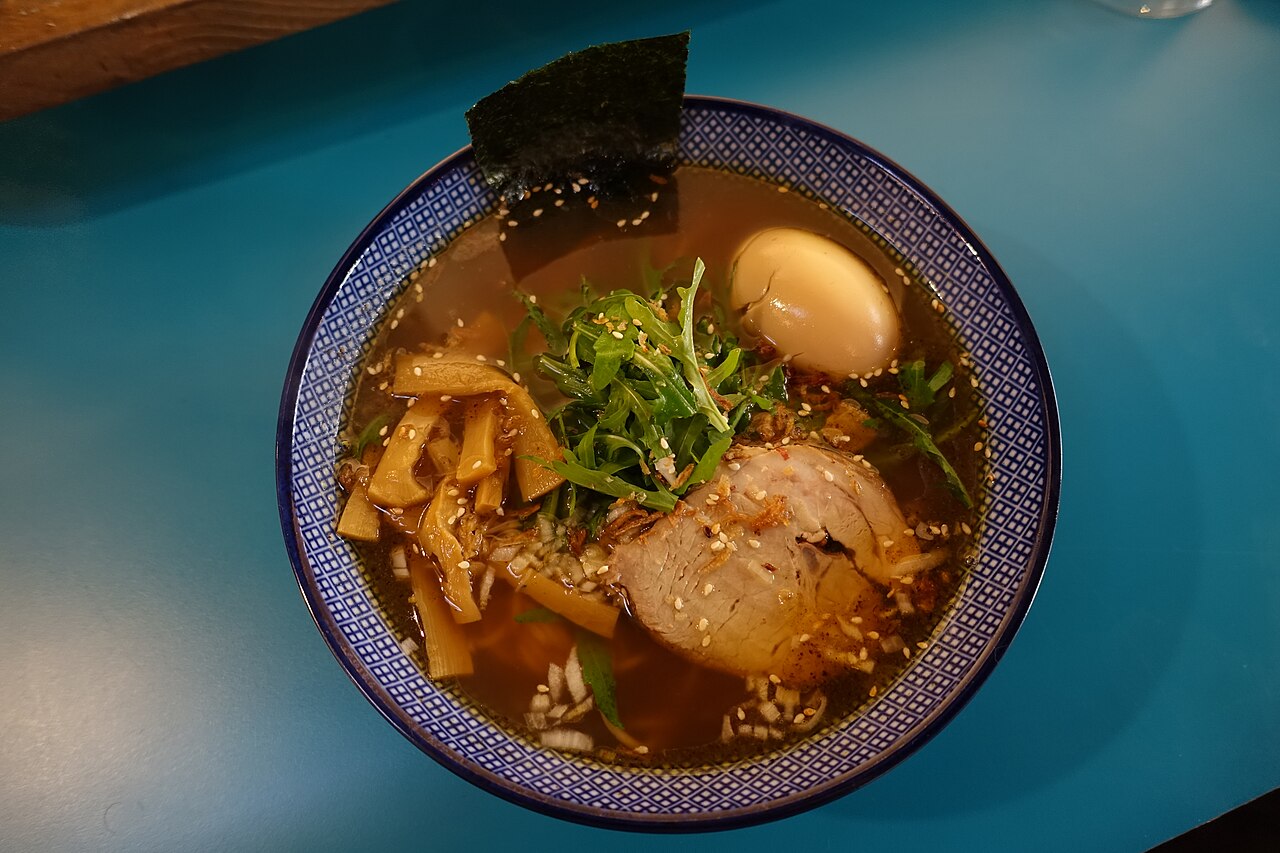
Shoyu ramen is the bowl most people picture when they think of ramen: clear amber soup, curly noodles, a slice of pork and a sheet of nori (toasted seaweed). Tokyo has been eating it since the early twentieth century, often under its older name, chuka soba, and it's still the bowl every other style is measured against.
The soup is two things kept apart until the last moment. The broth is chicken, simmered gently so it stays clear, then steeped like a dashi (Japanese stock) with kombu (dried kelp) and katsuobushi (smoked, dried bonito flakes) for a quiet note of the sea. The tare, the seasoning concentrate that goes into each bowl first, is soy sauce rounded with mirin (sweet rice seasoning) and a little sake (rice wine). A spoonful of chicken fat on top carries the aroma.
Plan ahead: the ajitama (marinated soft-boiled eggs) need at least 4 hours in their marinade, so start them first, or the night before. And protect the last two minutes. Noodles that sit, or go into the bowl dripping wet, water down a soup that took all afternoon.
Ingredients
Marinated eggs (ajitama)
Broth
Chashu (rolled braised pork belly)
Shoyu tare
Chicken oil
To serve
Method
Tap a step's number to tick it off, and a time to start a timer.
Start the eggs (at least 4 hours ahead)
Bring the sake and mirin for the eggs to a boil in a small pan and let them bubble for 30 seconds to cook off the alcohol. Take off the heat, stir in the soy sauce and water, and leave to cool completely; standing the pan in cold water speeds this up.
Bring a pan of water to a rolling boil. Lower in the cold eggs with a spoon and boil for 6 1/2 minutes, rolling them gently for the first minute so the yolks set in the centre. Lift them straight into a bowl of iced water and leave until completely cold, about 10 minutes.
Tap each egg all over and peel it under water, starting from the wide end where the air pocket is. Put the eggs in a zip-lock bag with the cold marinade and press out the air, or use a snug container with a sheet of paper towel on top to keep them submerged. Refrigerate for at least 4 hours, ideally overnight.
Start the broth
Put the carcasses and wings in a large pot, cover with cold water and bring to a boil over high heat. Boil for 3 minutes, then drain and rinse every piece under cold running water, pulling out blood clots and the dark kidney tissue tucked along the backbones. Wash the pot.
Return the chicken to the clean pot with the 3 l cold water and bring it slowly to a bare simmer over medium heat, 20–30 minutes, skimming off the grey foam as it gathers. Then turn the heat down until the surface barely trembles, with a bubble breaking every second or two.
Simmer like this, uncovered and without stirring, for 2 hours, skimming now and then. If the bones start to poke out, top up with a little hot water.
Braise the chashu (while the broth simmers)
Lay the belly fat side down and roll it up tightly into a log, so the fat ends up on the outside. Tie it with butcher's twine at 2–3 cm intervals.
Heat the oil over medium-high heat in a heavy pot that holds the roll snugly. Brown the pork on all sides until deep golden, 8–10 minutes, then pour off most of the rendered fat.
Add the soy sauce, sake, mirin, sugar, water, ginger and spring onions; the liquid should come about halfway up the pork. Bring to a boil, then turn the heat to low and cover with an otoshibuta (a drop lid that sits right on the food) or a circle of baking paper. Simmer gently for 2 1/2 hours, turning the roll every 30 minutes and adding a splash of water if the liquid drops below a quarter of the way up, until a skewer slides in with almost no resistance.
Take the pot off the heat and leave the pork to cool in its liquid for at least 30 minutes. For the neatest slices, cool it completely, then chill it overnight in the liquid.
Make the tare and the oil
For the tare, bring the mirin and sake to a boil in a small pan and bubble for 30 seconds. Add the soy sauce and kombu and heat over low heat until steaming, with tiny bubbles at the edge, 3–4 minutes; don't let it boil. Take off the heat, leave to steep for at least 30 minutes, then lift out the kombu.
For the oil, chop the chicken skin and fat and put it in a small pan with the water over low heat. Cook gently, stirring now and then, until the fat has rendered out and the skin is golden and crisp, 30–40 minutes. Add the spring onion and ginger for the last 10 minutes, until shrivelled and golden. Strain and set aside; you need 1 tbsp per bowl. If you're short, make it up with fat skimmed from the broth.
Finish the broth
When the broth has simmered for 2 hours, add the onion, ginger, garlic and leek greens and simmer for 1 hour more.
Strain the broth through a fine sieve lined with damp muslin or paper towel into a clean pot, without pressing on the solids. You should have about 2 l, and you need 375 ml per bowl.
Set the pot over the lowest heat, add the kombu and keep the broth steaming but not bubbling for 20 minutes. Lift out the kombu, turn off the heat, scatter over the katsuobushi and leave for 5 minutes, until the flakes sink. Strain again through the lined sieve without squeezing; squeezing clouds the broth and makes it taste fishy.
Assemble
Lift the eggs out of the marinade and leave them at room temperature while you get everything else ready. Bring a large pot of unsalted water to a rolling boil for the noodles, fill the bowls with hot water to warm them, and bring the broth back to a gentle simmer.
Untie the chashu and cut it into 5 mm slices. Warm the slices in a dry frying pan over medium heat until the fat glistens, 30–60 seconds a side. Halve the eggs lengthways with a thin, sharp knife.
Empty the bowls and put 40 ml (about 2 1/2 tbsp) tare and 1 tbsp chicken oil in each.
Shake the noodles loose and drop them into the boiling water, two portions at a time unless your pot is very large. Stir with chopsticks for the first 30 seconds so they don't clump, and cook as the packet says, usually 1 1/2–2 1/2 minutes. While they cook, ladle 375 ml hot broth into each bowl and stir.
Drain the noodles thoroughly, shaking the sieve hard, then slide them into the soup and fold them into a neat bundle with chopsticks. Top with chashu, egg halves, menma and spring onions, and tuck the nori upright against the side of the bowl so it stays crisp. Serve at once, with white pepper on the table.
Swaps
Cooking for coeliac disease or an allergy? Check every label: the notes below say which ones matter.
Gluten-free
- Use tamari labelled gluten-free in place of the koikuchi soy sauce in the tare, the egg marinade and the chashu, in the same amounts. It's thicker and darker, with less of koikuchi's toasty aroma, so the soup comes out deeper in colour and a little heavier; taste the first bowl and adjust the tare.
- Ramen noodles are wheat: use noodles labelled gluten-free (rice, or brown rice and millet ramen-style noodles). They lack the springy, alkaline bite, so it's a softer bowl and not quite the same dish. Check the sake and mirin labels, and leave out the menma unless it's labelled gluten-free, as it's usually seasoned with soy sauce.
Plant-based
- Replace the chicken broth with a kombu-shiitake broth: soak 30 g kombu and 6 dried shiitake in 2 l cold water for at least 3 hours, heat it slowly and lift out the kombu just before it boils, then simmer with the onion, ginger, garlic and leek greens for 30 minutes and strain. Skip the katsuobushi. The tare is already vegan.
- Make the aroma oil by warming 4 tbsp neutral oil gently with the spring onion and ginger instead of the chicken fat, and simmer thick slices of firm tofu in a half batch of the chashu liquid (no pork) for 15–20 minutes in place of the chashu. Leave out the eggs, and check that the noodles are egg-free and the menma has no fish-based seasoning.
- It's a good vegetable shoyu ramen, but lighter and earthier than the chicken original rather than a copy of it.
High-protein
- Marinate a second egg per person: cook 8 eggs and double the marinade. Each adds about 6 g protein.
- Poach 2 small chicken breasts (about 350 g) in the broth for its last 20 minutes in step 13, until the thickest part reads 74°C, then slice and add to the bowls with the chashu: about 20 g more protein per bowl.
Tips
- Keep the broth at a tremble. A rolling boil churns fat and protein into the liquid and turns it cloudy and heavy-tasting. At a bare simmer they rise to the surface, where you can skim them off. If you see big bubbles, turn it down.
- Taste the first bowl before the noodles go in. With tare and broth stirred together it should taste fully seasoned, even a touch salty on its own, because the noodles take up some of the seasoning. Soy sauces vary, so adjust with 1 tsp more tare at a time.
- Use Japanese-style soy sauce. Koikuchi is brewed from soybeans and wheat, and its toasty roundness is the flavour of the soup. Chinese dark soy is too thick and sweet for this; Chinese light soy works but tastes sharper, so start with a little less and taste.
- Boil a spare egg. Soft-boiled eggs tear easily when you peel them. The yolks are only partly set, so for anyone pregnant, very young, elderly or with a weakened immune system, boil the eggs for 9 minutes instead.
- Finding things. Kombu, katsuobushi and menma are sold in Japanese and most East Asian grocers, and a butcher can usually supply chicken carcasses and skin. If you can't get skin, warm 4 tbsp lard with the spring onion and ginger for the oil instead.
Make ahead and storage
- The broth keeps for 3 days in the fridge or 3 months in the freezer. Cool it fast by standing the pot in a sink of iced water and stirring, and refrigerate within 2 hours.
- The tare keeps for a month in a sealed jar in the fridge, and tastes rounder after a day or two.
- The chashu keeps for 4 days in its liquid in the fridge. Sliced and wrapped, it freezes well for up to 2 months.
- The eggs are at their best after 1–2 days in the marinade and keep for up to 3 days; after that they turn salty and firm.
- Keep the chashu liquid. Strain it, lift off the fat once it's chilled, and store it in the fridge for up to a week. Boiled and cooled, it makes a deeply flavoured marinade for the next batch of eggs.
- The chicken oil keeps for 4 days in the fridge, or 1 month in the freezer.
Variations
- Niboshi broth: For a stronger, more old-school Tokyo flavour, swap the katsuobushi for 20 g niboshi (dried sardines) with the heads and dark guts pulled off. Add them to the strained broth with the kombu in step 15, keep it steaming for 20 minutes, then strain.
- Chicken and pork: For a rounder, meatier broth, closer to many classic chuka soba shops, add 500 g pork bones. Boil them for 10 minutes in step 4, adding the chicken for the last 3 minutes, scrub them clean, and simmer them with the chicken.
- Shortcut broth: Steep 1.7 l good unsalted chicken stock with the kombu and katsuobushi as in step 15. It won't have the same body, but it makes a very good weeknight bowl.
Don't feel like cooking?
Places serving shoyu ramen in Japan
From the Soupmap catalog: places whose names point to the style, picked across cities. Listings, not reviews; check before you go.
- Kitakata Ramen Tate Honkan 喜多方ラーメン館本館 Kitakata, Fukushima · where the style comes from Map
- Chuka Soba Fujii Ashiharabashi Honten 中華そば ふじい 芦原橋本店 Osaka Map
- Chuka Soba Fujiya 中華そば 冨士屋 Okayama Map
- Chuka Soba Hirakoya Kiboshi 中華そば ひらこ屋 きぼし Aomori Map
- Chuka Soba Kiichi 中華そば 嘉一 Sendai, Miyagi Map
- Aji Marushitei Chuka Soba 味まるシティ中華そば Wakayama Map
See them on the map Chuka soba in every city
City guidesKitakata ramen in Kitakata 5Chuka soba in Osaka 51Chuka soba in Okayama 33Chuka soba in Aomori 30Chuka soba in Sendai 29Chuka soba in Wakayama 28
Your notes
Keep your cooking notes private in your account. Save what you changed and what you'd do next time.
Reviews & cooks' tips
Reviews and tips from people who've cooked this appear here.