
Japan · Noodle soups
Chicken paitan ramen (tori paitan)
Chicken bones boiled hard for hours into a thick, milky broth, with a clean salt tare and juicy poached breast. Creamy ramen without a drop of cream.
- Prep
- 40 min
- Cook
- 4 hr 10 min
- Total
- 5 hr
- Effort
- A project
- Serves
- 4
The total includes 10 min of soaking, resting or chilling.
Ratings by the Soupmap Culinary Team, not readers.
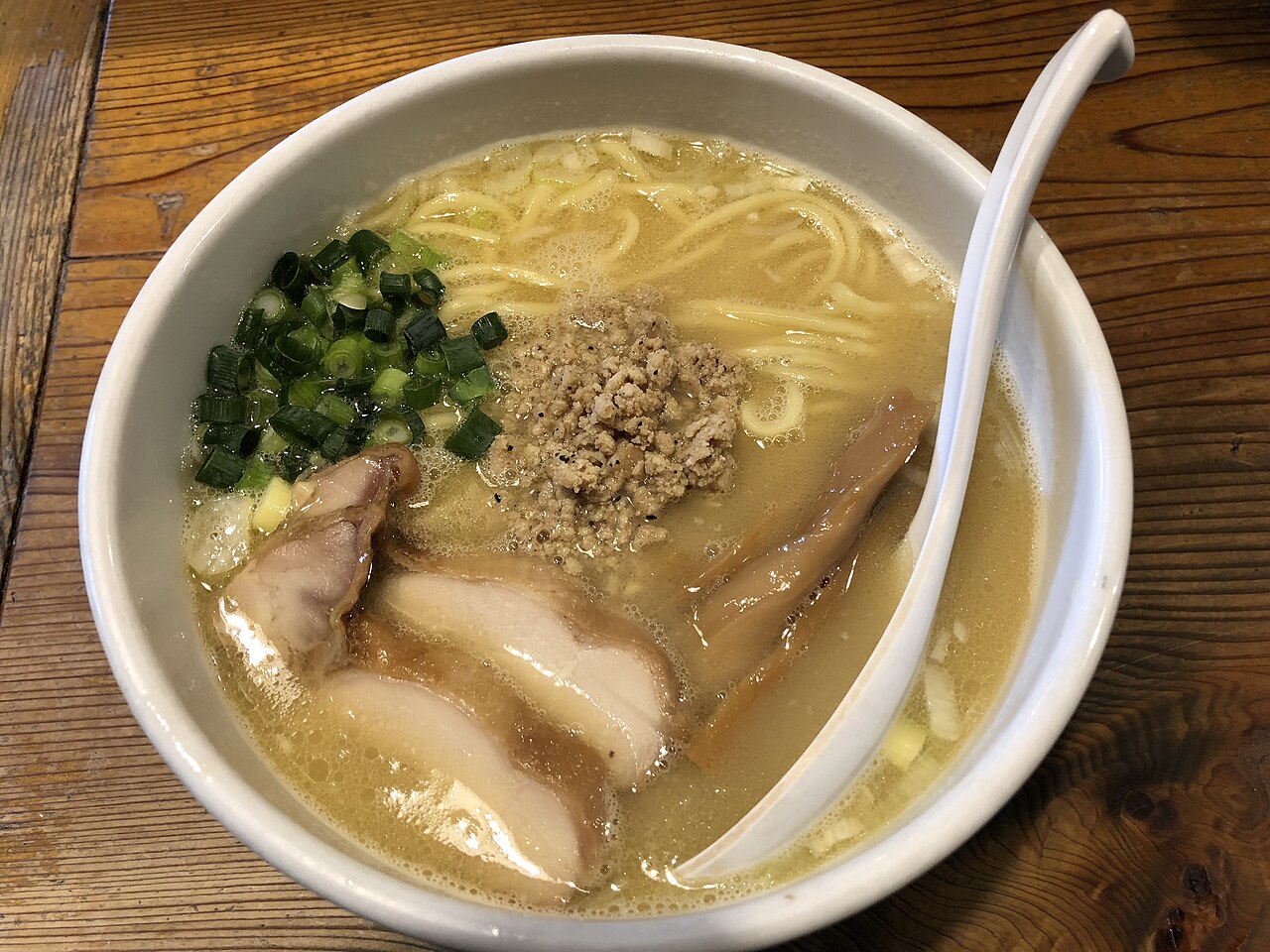
Tori paitan ("white chicken soup") is chicken ramen with the body of tonkotsu (pork-bone ramen): opaque, glossy and so rich it coats your lips, yet made from nothing but chicken, water and time. It has become a fixture of modern ramen in Japan, and it's well within reach at home if you give it an afternoon.
The method is the opposite of a clear stock. For a clear chintan you keep the pot at a bare simmer; for paitan you keep it at a hard, rolling boil for hours. The churning breaks the chicken fat into tiny droplets, while collagen from the feet and skin dissolves into gelatin that coats those droplets and holds them in suspension. The result is an emulsion, and a short blitz with a blender at the end makes it almost creamy.
Where people go wrong is the heat. A polite simmer gives you a thin, greasy soup with fat floating on top. Keep it roaring, keep the bones covered and scrape the bottom so nothing catches. The salt tare (the seasoning concentrate that goes into each bowl) is kept simple so the chicken leads.
Ingredients
Broth
Shio tare
Chicken chashu
Aroma oil
To serve
Method
Tap a step's number to tick it off, and a time to start a timer.
Prepare the bones
If the chicken feet still have their claws, snip them off with kitchen scissors. Rinse the carcasses under cold running water, pulling out any blood clots and the dark red kidneys tucked along the backbone, which would make the broth taste murky.
Put the carcasses, feet and wings in a stockpot that holds at least 8 l, cover with cold water and bring to a boil over high heat. Boil for 5 minutes, then drain, rinse each piece under cold water to wash off the scum, and wash out the pot.
Crack the carcasses into pieces with the back of a heavy cleaver, or press down hard on them with a rolling pin, to expose the marrow.
Boil the broth
Return all the bones to the clean pot, add the 4 l water and bring to a hard boil over high heat. Skim off any foam for the first 15 minutes, then leave the pot uncovered at a full, rolling boil, the surface churning rather than trembling, for 3–4 hours.
Every 30 minutes, top up with boiling water from a kettle to keep the bones just covered, and stir, scraping the bottom with a flat-ended wooden spoon so nothing sticks. After about 1 1/2 hours, when the wings and carcasses are falling apart, crush everything firmly with a potato masher. The broth will turn from cloudy grey to milky ivory.
For the last hour, add the onion, garlic, ginger and leek tops. Stop topping up for the final 30 minutes and let the broth reduce; it's ready when it looks like thin cream and a drop feels sticky between your fingertips once it has cooled.
Make the tare, chashu and oil (while the broth boils)
Peel the skin off the chicken breasts and set it aside for the oil. Rub the breasts all over with the salt and sugar, cover and refrigerate for at least 30 minutes (or up to 1 day).
For the tare, put the 150 ml water, sake, mirin and kombu in a small saucepan and leave to soak for 15 minutes. Heat until small bubbles appear, remove the kombu, add the katsuobushi and simmer for 1 minute, then turn off the heat and leave for 5 minutes. Strain, return to the pan and stir in the salt until it dissolves; you'll have about 170 ml.
For the aroma oil, chop the chicken skin, put it in a small pan with the oil and cook over low heat, stirring now and then, until the skin is crisp and golden and the fat has rendered out, 20–25 minutes. Add the spring onion greens and garlic and cook until golden, about 5 minutes, then strain and discard the solids.
For the chashu, heat the 3 l water with the ginger in a large pot to 70°C (158°F) on a probe thermometer. Lower in the breasts and adjust the heat so the water stays at 68–70°C (154–158°F), checking every 10 minutes and adding a splash of cold water if it creeps higher. Cook until the thickest part of each breast reads 65°C (149°F), 40–60 minutes, then keep them in the water, still held at 68–70°C (154–158°F), for 10 minutes more so the centre stays at 65°C or above the whole time.
Lift out the breasts, let them cool, then wrap and refrigerate until needed. Slice thinly, about 5 mm thick, just before serving.
Finish the soup
Strain the broth through a fine sieve into a clean pot, pressing hard on the solids with a ladle; unlike a clear stock, you want everything that pushes through. You're aiming for about 1.6 l, so boil it down if there's more, or add a little hot water if there's much less.
Bring the broth back to a boil, then blend it with a stick blender for 30–60 seconds, until smooth, frothy and slightly thicker. (If you use a jug blender, fill it no more than a third full, take out the centre of the lid and cover the hole with a folded towel.) Keep it hot over low heat.
Assemble the bowls
Bring a large pot of water, at least 4 l, to a rolling boil and fill the serving bowls with hot water to warm them. Empty the bowls and put 2 tbsp tare and 1 tbsp aroma oil in each.
Drop the noodles into the boiling water and cook as the packet says, usually 1–2 minutes for medium-thin noodles. While they cook, pour about 350 ml of steaming soup into each bowl and stir; taste one and add up to 1/2 tbsp more tare if it needs it.
Drain the noodles, shaking hard to get rid of the water, and fold them into the soup. Top with sliced chashu, menma, spring onion and a piece of nori, and serve at once.
Swaps
Cooking for coeliac disease or an allergy? Check every label: the notes below say which ones matter.
Gluten-free
- Ramen noodles are made from wheat, so you'll need noodles labelled gluten-free, such as rice or rice-and-millet ramen-style noodles. They're softer and lack the springy bite of alkaline wheat noodles, so it's a gluten-free chicken paitan rather than quite the same bowl.
- The broth, shio tare and aroma oil are free of gluten, but check that the mirin is labelled gluten-free. Menma is usually seasoned with soy sauce, so use plain bamboo shoots or one labelled gluten-free, and if you make the shoyu tare, use tamari labelled gluten-free.
Plant-based
- There's no vegan version of this broth: paitan is chicken collagen and fat boiled into an emulsion. The nearest plant-based bowl is a soy-milk ramen. Warm equal parts unsweetened soy milk and kombu-shiitake dashi without letting it boil, season it with the shio tare made without the katsuobushi, and swap the aroma oil for one made by frying the spring onion greens and garlic in neutral oil alone.
- Top it with sliced fried tofu instead of chashu, and check the noodle label, as some ramen noodles contain egg.
High-protein
- Poach a third chicken breast (about 275 g) with the other two in step 10: about 14 g more protein a bowl, on top of the roughly 25 g the chashu already gives.
- Add an ajitama (see Variations) to each bowl for about 6 g more.
Tips
- Keep it at a rolling boil. The emulsion only forms with real violence in the pot. Top up with boiling water from the kettle, never cold, which stalls the boil.
- Don't skip the feet. They're mostly skin, tendon and collagen, and they give paitan its body. Asian grocers and many butchers sell them; without them, use extra wings, and the soup will be thinner but still good.
- Watch the bottom of the pot. As the broth reduces, bits of bone and collagen settle and can scorch, and a burnt taste runs through the whole pot. If it does catch, pour the broth into a clean pot without scraping up the burnt layer.
- The seasoning goes in the bowl, not the pot. Keeping the broth unseasoned lets you season each bowl precisely and stops the pot getting saltier as it reduces. There's more on why in the anatomy of a ramen bowl.
- Cook the chashu by thermometer. Holding the centre at 65°C (149°F) for 10 minutes is a recognised safe equivalent to 70°C (158°F) for 2 minutes, and it keeps the breast juicy. Without a thermometer, don't try the low-temperature method: poach the breasts at a bare simmer for 15–20 minutes, until white right through with clear juices.
- Blend just before serving. The froth and extra body fade as the soup sits, and broth that has been chilled always needs a fresh blitz.
Make ahead and storage
- The broth keeps for 3 days in the fridge or 3 months in the freezer. Cool it quickly by dividing it between shallow containers set in iced water, and refrigerate within 2 hours. It sets to a firm jelly; reheat it to a full boil and blend again.
- The shio tare keeps for 1 month in the fridge.
- The aroma oil keeps for 4 days in the fridge, or 1 month in the freezer.
- The chashu keeps for 3 days in the fridge.
Variations
- Shoyu tare. Bring 30 ml mirin and 2 tbsp sake to a boil for 1 minute, add 120 ml soy sauce and a 5 cm square of kombu, and warm until steaming but not boiling. Leave for 30 minutes, remove the kombu, and use 2 tbsp per bowl, with a pinch of salt if it needs it. The broth turns light caramel and tastes rounder and deeper.
- Ajitama (marinated eggs). Lower 4 fridge-cold eggs into boiling water for 6 1/2 minutes, cool them in iced water and peel. Bring 4 tbsp each of soy sauce, mirin and water to a boil, let it cool, then marinate the eggs in it in the fridge for 4–24 hours. The yolks stay runny, so for anyone who should avoid undercooked eggs (pregnant women, young children, older people or anyone with a weakened immune system), boil them for 10 minutes, until the yolks are firm right through.
- Vegetable paitan. Some shops blend cooked vegetables into the soup for sweetness and body: simmer 1 sliced onion and 200 g cabbage in a ladle of broth until very soft, and blend them in at step 13.
Don't feel like cooking?
Places serving chicken paitan ramen in Japan
From the Soupmap catalog: places whose names point to the style, picked across cities. Listings, not reviews; check before you go.
- Ramen Atsuta Tori Paitan Niwatori Shin らーめん 熱田鶏白湯鶏神 Nagoya, Aichi Map
- Ramen Izumi Tori Paitan Niwatori Shin らーめん泉鶏白湯鶏神 Nagoya, Aichi Map
See them on the map Tori paitan ramen in every city
City guidesTori paitan ramen in Nagoya 6
Your notes
Keep your cooking notes private in your account. Save what you changed and what you'd do next time.
Reviews & cooks' tips
Reviews and tips from people who've cooked this appear here.