
Vietnam · Noodle soups
Phở gà (Vietnamese chicken noodle soup)
A whole chicken poached gently in a broth of charred onion, ginger and toasted spice, then torn over rice noodles with herbs, lime leaf and lime. Lighter than beef, done in an afternoon.
- Prep
- 20 min
- Cook
- 2 hr 35 min
- Total
- 3 hr
- Effort
- Takes some care
- Serves
- 4
Ratings by the Soupmap Culinary Team, not readers.
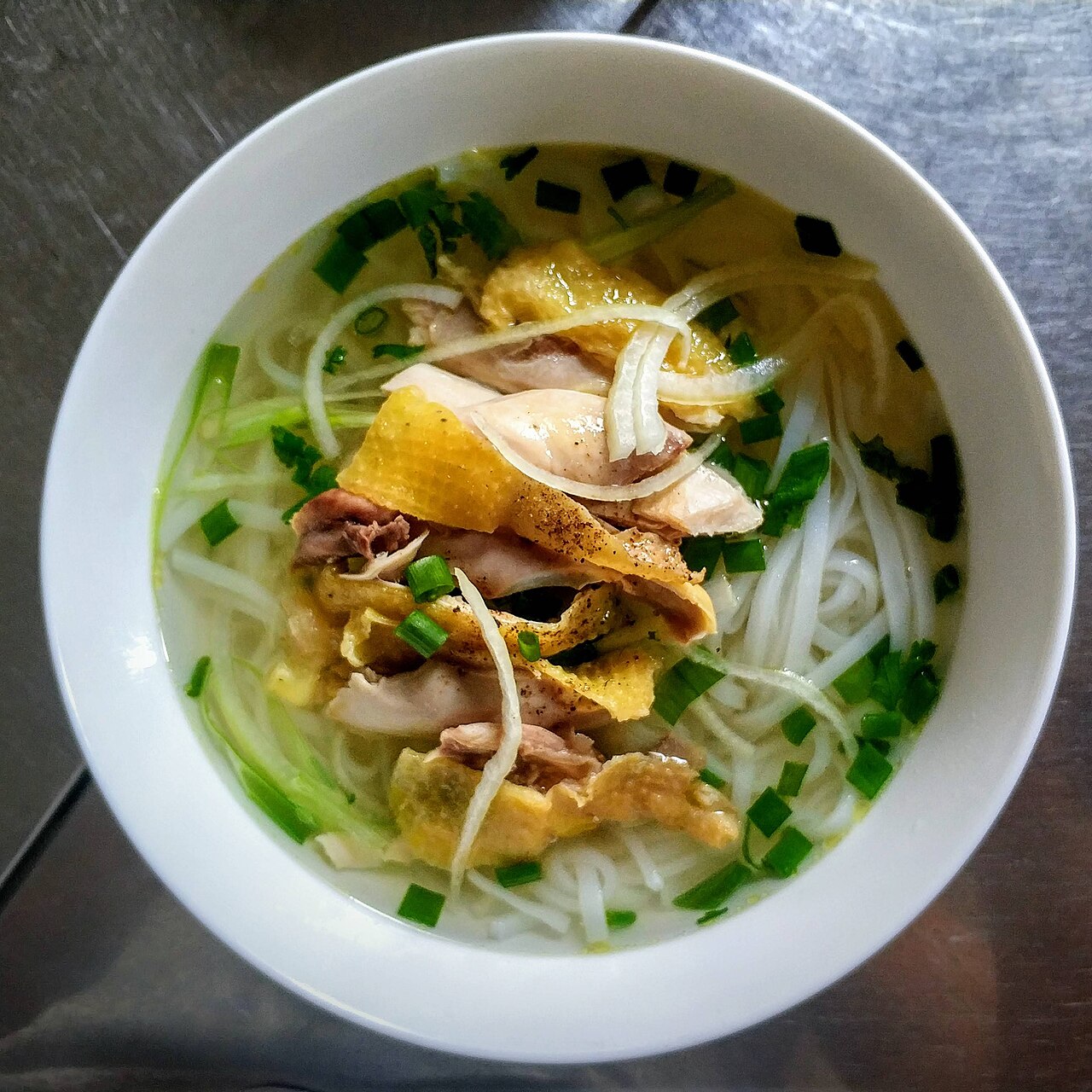
Phở gà is the chicken version of phở, Vietnam's best-known noodle soup (gà means chicken). It's paler and lighter than beef phở but built on the same idea: a clear broth perfumed with charred onion, ginger and whole spices, poured over flat rice noodles. In Hanoi it often comes with a pinch of finely shredded lime leaf on top, and I think that small, sharp perfume is what makes the bowl.
The whole chicken does two jobs. It poaches gently until just cooked, then comes out for an ice bath that firms the skin and keeps the meat juicy, while its carcass goes back in to finish the stock. A few extra wings or backs give the broth the body that one supermarket bird can't manage alone.
The usual mistake is boiling. A hard boil clouds the broth and turns the breast stringy and dry, so keep the pot at a lazy simmer from start to finish. There's more on phở in our essay, and the beef version is phở bò.
Ingredients
Broth
To serve
Method
Tap a step's number to tick it off, and a time to start a timer.
Blanch the wings and char the aromatics
Put the wings or backs in a large pot (about 8 l), cover with cold water and bring to a boil over high heat. Boil for 5 minutes, then drain, rinse off the scum and wipe out the pot.
Meanwhile, char the onion and ginger under a very hot grill (broiler), turning once, or hold them over a gas flame with tongs, until blackened in patches and starting to soften, 15–20 minutes under the grill or about 10 minutes over a flame. Peel off the burnt onion skin, scrape the worst of the black from the ginger with a spoon and rinse briefly.
Poach the chicken
Put the blanched wings back in the pot with the whole chicken, breast side down, and the 3 l cold water. Bring slowly up to a simmer over medium heat, 20–25 minutes, skimming off the foam as it rises.
Add the charred onion and ginger and turn the heat down until the surface barely trembles, with just the odd bubble. Poach until the thickest part of a thigh reads 74°C (165°F) and the juices run clear when pierced, 35–45 minutes, turning the chicken over halfway if its top sits out of the water.
Lift the chicken out, tipping the liquid from its cavity back into the pot, and plunge it into a large bowl of iced water for 10 minutes. This stops the cooking, firms the skin and keeps the meat juicy.
Pull the meat off the bones in large pieces, then cover and refrigerate it. Return the carcass, and any skin you don't want to eat, to the pot and keep it at a bare simmer for 1 hour more.
Spice, strain and season
When the carcass has been back in for 20 minutes, crack the black cardamom (if using) with the flat of a knife and toast it with the star anise, cassia, cloves and coriander seeds in a dry frying pan over medium-low heat, shaking the pan, until fragrant, 2–3 minutes. Tie them in a square of muslin (cheesecloth) or put them in a tea infuser and add them to the pot for the remaining 40 minutes.
While the broth finishes, soak the noodles in a large bowl of room-temperature water until pliable and opaque white, 30–45 minutes, then drain.
Lift out the bones and aromatics, then strain the broth through a fine sieve lined with damp muslin into a clean pan and skim off most of the fat. You want about 500 ml per bowl, so 2 l for four: boil it down or top up with hot water as needed.
Bring the broth back to a simmer and add the rock sugar, the salt and about two-thirds of the fish sauce, stirring until dissolved, about 5 minutes. Taste, adding more fish sauce and salt until it tastes slightly too salty on its own, since the noodles will soften it.
Assemble
Tear the chicken into bite-sized strips. Bring a pan of water and the broth to a rolling boil, and warm the bowls with hot water from the kettle.
Working one portion at a time, dip the noodles in the boiling water in a sieve until soft but still springy, 20–30 seconds, then shake dry and tip into a bowl. Warm a portion of chicken in the boiling broth in a ladle or sieve for 30 seconds and lay it over the noodles.
Ladle about 450 ml of boiling broth into each bowl and scatter with spring onion, coriander, a pinch of shredded lime leaf and black pepper. Serve at once, with lime wedges and chillies on the side.
Swaps
Cooking for coeliac disease or an allergy? Check every label: the notes below say which ones matter.
Gluten-free
- Already gluten-free as written. Check the fish sauce, since a few brands add hydrolysed wheat protein, and choose rice noodles labelled gluten-free, as some are made on lines shared with wheat.
- If you set out hoisin as in the Variations, use one labelled gluten-free: most contain wheat.
Plant-based
- There's no phở gà without the chicken, but phở chay, the vegetarian phở of Vietnam's Buddhist kitchens, works on the same frame: simmer the charred onion and ginger in 3 l water with about 600 g daikon (white radish) and 2 carrots in large chunks, 1 corn cob and 20 g dried shiitake for 1 hour, adding the toasted spices for the last 40 minutes. It's lighter and sweeter, and a different soup.
- Season with salt and a little tamari labelled gluten-free (or soy sauce, if gluten isn't a concern) instead of fish sauce, and top with fried tofu and torn, seared oyster mushrooms. Keep the lime leaf: it carries the bowl's perfume either way.
High-protein
- Poach 2 boneless, skinless chicken breasts (about 400 g) alongside the whole bird for the last 15–20 minutes of step 4, until the thickest part reads 74°C, and chill them in the ice bath with it: about 23 g more protein per bowl.
- A halved hard-boiled egg per bowl adds about 6 g.
Tips
- Never let it boil. At a bare simmer, the proteins that would cloud the broth set into clumps you can skim off or strain out, and the breast meat stays silky. A rolling boil breaks them up, churns the fat into the liquid and tightens the meat.
- Don't skip the ice bath. It's the Vietnamese way with poached chicken: the sudden chill stops the meat overcooking from the inside and gives the skin a pleasant snap.
- Build body with bones. Wings, backs or a couple of chicken feet add the gelatine a single bird lacks. A free-range or older bird has noticeably more flavour, though it may take longer to poach, so go by the thermometer.
- Shred the lime leaf finely. Stack the leaves, roll them tightly and slice with your sharpest knife as thin as you can. In Hanoi the leaf is usually from the ordinary lime tree (lá chanh), which is gentler; makrut leaves are the easier-to-find stand-in and much stronger, so a pinch per bowl is plenty.
- Keep the spice light. Chicken is more delicate than beef, so the spices here are fewer and spend only 40 minutes in the pot. Lift the bag out sooner if the anise starts to dominate.
Make ahead and storage
- Cool the broth quickly in shallow containers or with the pot in a sink of iced water, and refrigerate within 2 hours. It keeps for 3–4 days in the fridge or 3 months in the freezer; bring it back to a full boil before serving.
- The poached chicken keeps, covered, for 3 days in the fridge. Warm it in the boiling broth as in step 12 rather than reheating it separately.
- Store the noodles, herbs and broth separately.
Variations
- Southern-style table: serve with bean sprouts, Thai basil and extra lime, and hoisin and chilli sauce on the side. Most hoisin contains wheat, so check the label if you need the meal gluten-free.
- Chicken on the side: serve the meat on a separate plate with a dip of salt, black pepper and lime juice (muối tiêu chanh), and keep the bowl for noodles and broth.
- Richer broth: add 4–6 chicken feet, blanched with the wings, for a broth with more body and a silkier feel.
Your notes
Keep your cooking notes private in your account. Save what you changed and what you'd do next time.
Reviews & cooks' tips
Reviews and tips from people who've cooked this appear here.