
South Korea · Hot pots & stews
Sundubu jjigae (soft tofu stew)
Custard-soft tofu and pork in a fiery red broth, built on chilli oil made in the pot and finished with an egg cracked into the bubbling stew.
- Prep
- 10 min
- Cook
- 35 min
- Total
- 45 min
- Effort
- Easy
- Serves
- 4
Ratings by the Soupmap Culinary Team, not readers.
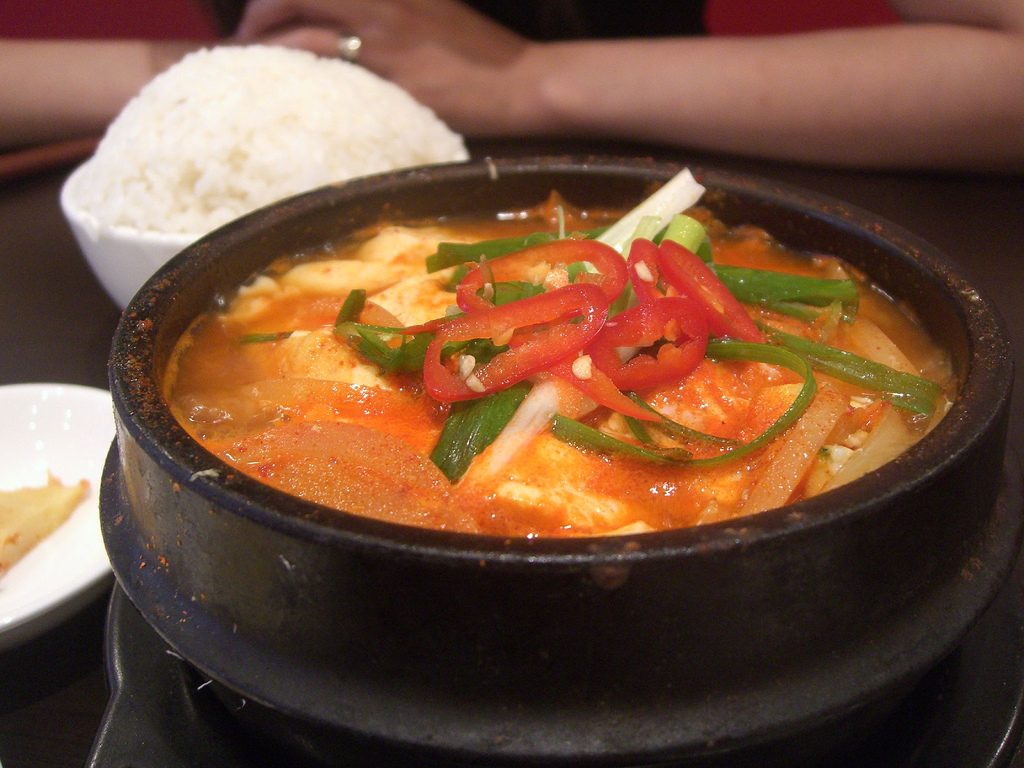
Sundubu jjigae is a stew (jjigae) built around sundubu, extra-soft tofu that is never pressed, so it stays as delicate as custard. It goes into a red, chilli-hot broth with pork or seafood, and an egg is cracked in at the last moment to poach in the bubbling pot. The point is the contrast: fierce broth, trembling tofu, rich yolk.
The heat and colour come from chilli oil that you make in the pot at the start. Garlic, spring onion and pork go into the oil first, then gochugaru (Korean chilli flakes, bright red and fruity rather than scorching) is stirred through over low heat until the oil turns brick-red. Those few minutes of gentle frying are the whole flavour base, and they are where most attempts go wrong: chilli flakes burn in seconds over high heat and turn the stew bitter. Keep the heat low and have the stock ready to pour in.
Then handle the tofu as little as possible. Spoon it into the pot in big pieces and let the simmer break it up; stirring hard turns it to mush.
Ingredients
Anchovy-kelp stock
Stew
Method
Tap a step's number to tick it off, and a time to start a timer.
Make the stock
Toast the anchovies in a dry saucepan over medium heat for 1–2 minutes, until fragrant. Add the water and kelp, bring to a boil, then simmer for 5 minutes and lift out the kelp. Simmer for 10 minutes more and strain; you should have about 650 ml.
Make the chilli oil
Heat the oil in a wide, heavy pot over medium-low heat (or divide everything between two ttukbaegi, Korean earthenware pots). Add the garlic and spring onion whites and stir for 1 minute, until sizzling and fragrant but not browned.
Add the pork and onion, turn the heat to medium and stir-fry for 3–4 minutes, until the pork is no longer pink and some of its fat has rendered.
Turn the heat down to low and add the gochugaru. Stir constantly for 1 minute, until it forms a glossy, brick-red paste and the oil turns red; if it starts to darken or smell sharp, pull the pot off the heat. Stir in the guk-ganjang and fish sauce and let them sizzle for 30 seconds.
Simmer
Pour in 600 ml of the stock, turn the heat up and bring to a boil. Simmer for 5 minutes, so the pork cooks through and the chilli colours the broth.
Cut the tofu tubes in half and squeeze the tofu into the pot in large pieces, or scoop it in with a spoon. Add the green chilli and 1/2 tsp salt and simmer gently for 5 minutes without stirring, just nudging the tofu down into the broth, until it is hot all the way through. Taste and add more salt if needed: the broth should be boldly seasoned, because the tofu is bland.
Finish
Crack the eggs onto the surface, spacing them apart. Simmer for 1–2 minutes, until the whites just start to turn opaque at the edges, then scatter with the spring onion greens and a little black pepper.
Carry the pot to the table still bubbling, so the eggs keep cooking in the heat, and serve with rice.
Swaps
Cooking for coeliac disease or an allergy? Check every label: the notes below say which ones matter.
Gluten-free
- Not gluten-free as written: regular soy sauce contains wheat, and so do many guk-ganjang. Use the same amount of tamari labelled gluten-free, and check that the fish sauce is labelled gluten-free too.
- Check the gochugaru: pure chilli flakes are gluten-free, but seasoned blends may not be. If you add kimchi (see Variations), check its label as well. The tofu, anchovies, kelp and rice are naturally gluten-free.
Plant-based
- Not vegan as written (pork, anchovy stock, fish sauce and eggs). For a vegetable sundubu, make the stock with the kelp and 4 dried shiitake instead of the anchovies, lifting out the kelp after 5 minutes as before. Fry 200 g sliced fresh shiitake or diced courgette (zucchini) instead of the pork, with 1 tbsp more oil, and use a little more guk-ganjang, or tamari labelled gluten-free, instead of the fish sauce.
- Leave out the eggs. It's lighter and less deeply savoury, but the tofu and chilli oil keep it recognisably sundubu.
High-protein
- An extra egg per bowl: crack in 8 eggs instead of 4: about 6 g more protein per bowl.
- More meat: use 350 g pork shoulder instead of 200 g belly: about 9 g more per bowl.
- Add seafood too: 150 g peeled raw prawns for the last 2–3 minutes, until pink and opaque all the way through: about 7 g more per bowl.
Tips
- Low heat for the gochugaru. It scorches far faster than you'd expect. The paste should smell sweet and toasty; acrid or smoky means it has gone too far.
- About the egg: the yolk is meant to stay runny and the white soft. For anyone who should avoid undercooked eggs, such as pregnant women, young children, older people or anyone with a weakened immune system, cover the pot and simmer for 4–5 minutes, until white and yolk are both firm, or use pasteurised eggs.
- Taste after the tofu goes in. Sundubu releases water as it heats and dilutes the broth, so seasoning that tastes right before it goes in will taste flat after.
- Finding sundubu. It is sold in tubes in Korean and many Asian grocers. Japanese silken tofu (kinugoshi) is the closest substitute; avoid firm tofu, which never gives the same texture.
- Gochugaru isn't interchangeable. Western chilli flakes are hotter and seedier. If you can't find it, use 1 tbsp mild chilli flakes plus 1 tbsp sweet paprika for colour.
- If you use a ttukbaegi, heat it gradually from medium-low: earthenware can crack if a cold pot goes straight onto high heat.
Make ahead and storage
- Make the stock up to 3 days ahead; cool it quickly and keep it in the fridge.
- Sundubu jjigae is best eaten straight away. If you think you'll have leftovers, keep that portion back before the eggs go in; it keeps for 1 day in the fridge. Bring it back to a full boil and add fresh eggs.
Variations
- Seafood (haemul sundubu): skip the pork. Fry the garlic, spring onion and onion, make the chilli paste, then add the stock with 150 g small clams (scrubbed and purged) and boil until they open, 3–5 minutes, discarding any that stay shut. Add the tofu, then 150 g peeled prawns and sliced squid for the last 2–3 minutes, until the prawns are pink and the squid opaque.
- Kimchi sundubu: add 100 g chopped, well-fermented kimchi with the pork.
- Beef: use 200 g thinly sliced beef instead of the pork.
- Milder: use 1 tbsp gochugaru. The stew will be orange rather than red, but just as savoury.
Your notes
Keep your cooking notes private in your account. Save what you changed and what you'd do next time.
Reviews & cooks' tips
Reviews and tips from people who've cooked this appear here.