
Taiwan · Noodle soups
Taiwanese beef noodle soup
Beef shank red-braised with chilli bean paste, soy and star anise until spoon-tender, over chewy wheat noodles with bok choy and pickled mustard greens.
- Prep
- 15 min
- Cook
- 3 hr 15 min
- Total
- 3 hr 30 min
- Effort
- Takes some care
- Serves
- 4
Ratings by the Soupmap Culinary Team, not readers.
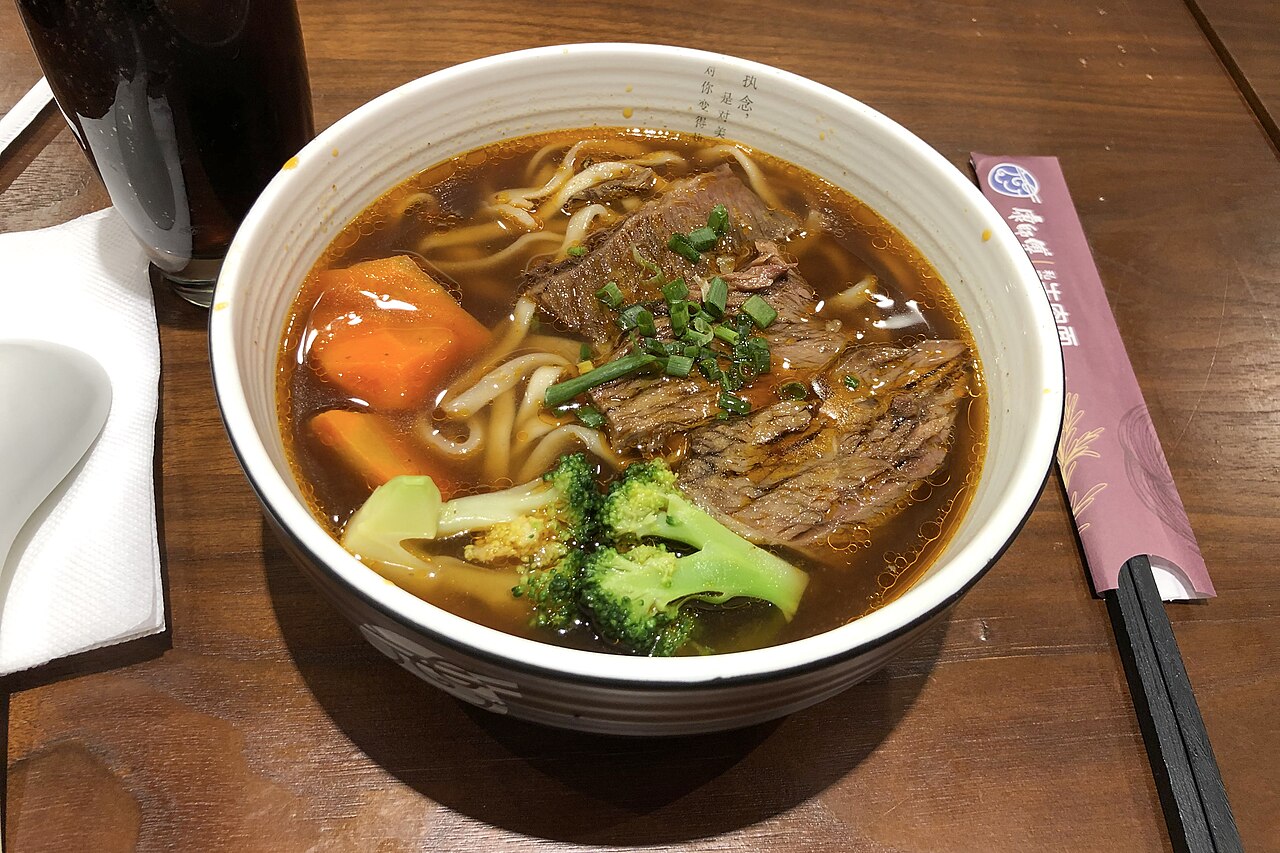
This is hong shao niu rou mian, red-braised beef noodle soup, a bowl Taiwan loves to argue about. Hong shao (red-braising) means slow-cooking meat in soy sauce with sugar and aromatics until it turns dark, glossy and tender; niu rou mian simply means beef noodles. Here the braise also takes doubanjiang, a fermented broad bean and chilli paste, which gives the broth its brick-red colour and a savoury, gently hot depth.
Beef shank is the cut to use. It is a hard-working muscle threaded with connective tissue that, after a couple of hours at a bare simmer, melts into gelatin, so the meat turns silky and the broth gains body. Cut it into big chunks: small pieces dry out before the connective tissue has time to soften.
The common mistake is letting the pot boil. A hard boil squeezes the moisture out of the meat, leaving it dry and stringy, and churns the fat into a cloudy broth. Keep it barely trembling, be patient, and finish each bowl with stir-fried pickled mustard greens, whose sourness and crunch cut through the richness. The story behind the dish is in our journal.
Ingredients
Braise
Spice bag
Pickled mustard greens
To serve
Method
Tap a step's number to tick it off, and a time to start a timer.
Blanch the beef
Put the beef in a large pot, cover with cold water and bring to a boil over high heat. Boil for 5 minutes, until a thick grey scum rises, then drain, rinse each piece under warm water and wash out the pot.
Build the braise
Tie the spice-bag ingredients in a square of muslin, or put them in a large tea infuser, so you won't be fishing out peppercorns later.
Heat the oil in a large, heavy pot (at least 5 l) over medium heat. Add the ginger, garlic, spring onions and onion and fry, stirring, for 3–4 minutes, until fragrant and just browning at the edges.
Turn the heat to low, add the doubanjiang and fry for 1–2 minutes, stirring constantly, until the oil turns red and smells rich and savoury; don't let it scorch. Add the tomatoes, if using, and cook for 2 minutes, until they start to collapse.
Add the beef, turn the heat to medium and stir for 2 minutes to coat it in the paste. Pour in the Shaoxing wine and let it bubble for 30 seconds, then add both soy sauces, the rock sugar, the spice bag and the 2.5 l water.
Bring to a boil and skim off any foam, then turn the heat down until only an occasional bubble breaks the surface. Cover with the lid slightly ajar and braise for 2 1/2 hours, stirring now and then.
Make the pickled greens (while the beef braises)
Soak the pickled mustard greens in cold water for 10 minutes to draw out some of the salt, then squeeze them dry and chop finely.
Heat the oil in a frying pan over medium heat and fry the garlic and chilli for 30 seconds. Add the greens and sugar and stir-fry for 3–4 minutes, until dry, glossy and fragrant, then set aside.
Finish the broth
Test a chunk of beef: a chopstick should slide in with little resistance while the meat still holds its shape. If it's still firm, braise for up to 30 minutes more and test again.
Lift out the spice bag and as much of the ginger and spring onion as you can find. Skim off some of the fat but not all of it; a little red oil on top is part of the bowl. You should have about 2 l of broth: taste it and add salt until it is well seasoned, even slightly strong, because the noodles will soak some of it up.
Cook and serve
Bring a large pot of water to a boil and warm 4 deep bowls. Blanch the bok choy for 1–2 minutes, until the stems are just tender, and lift it out.
Cook the noodles in the same water according to the packet, usually 3–5 minutes for fresh thick noodles, until cooked through but still chewy. Drain well.
Divide the noodles and beef between the bowls and ladle about 450 ml of boiling broth over each. Add the bok choy, spring onion and coriander, and put the pickled greens and chilli oil on the table.
Swaps
Cooking for coeliac disease or an allergy? Check every label: the notes below say which ones matter.
Gluten-free
- Not gluten-free as written: the noodles, both soy sauces and the Shaoxing wine contain wheat, and most doubanjiang is made with wheat flour. Use thick rice noodles labelled gluten-free, replace both soy sauces with 100 ml tamari labelled gluten-free, use dry sherry instead of Shaoxing wine, and find a chilli bean paste labelled gluten-free.
- Check the labels on the pickled mustard greens and chilli oil too. The broth comes out a shade paler and the noodles softer and less chewy, but the braise itself stays close to the original.
Plant-based
- The beef is the dish, so a vegan version is really a different soup: a red-braised mushroom noodle soup rather than niu rou mian.
- To make it, follow steps 2–6 without the beef, adding 6 dried shiitake, 500 g king oyster mushrooms in thick slices and 500 g daikon in large chunks, and braise for 45 minutes; add cubes of fried tofu for the last 10. Check that your doubanjiang, chilli oil and noodles contain no animal products (some wheat noodles contain egg).
High-protein
- Already generous: about 300 g raw shank per bowl, roughly 60 g protein.
- Braised eggs: simmer 4 peeled hard-boiled eggs in the braise for the last 30 minutes so they take on its colour, and halve one into each bowl: about 6 g more per bowl.
- Pressed tofu: add 200 g firm pressed tofu (dou gan), sliced, to the braise for the last 30 minutes: about 8 g more per bowl.
Tips
- Know your doubanjiang. Taiwanese chilli bean paste is smooth and fairly mild; Sichuan (Pixian) doubanjiang is saltier, chunkier and hotter. If you are using the Sichuan kind, chop it finely, start with 2 tbsp and make up any shortfall with salt at the end.
- Blanch, then barely simmer. Blanching removes the blood and loose proteins that would turn the broth murky and grey; the low simmer keeps the meat moist and the broth clear enough to show off its colour.
- Make it a day ahead if you can. Overnight the beef soaks up the braise, the flavours round out, and the fat sets on top so you can lift off exactly as much as you like.
- Cook the noodles separately, in plenty of water. Cooked in the broth, they shed starch that dulls and thickens it.
- Finding the pickles. Taiwanese suan cai (fermented mustard greens) is sold in vacuum packs in Chinese and Taiwanese grocers. Japanese takana-zuke (pickled mustard leaf) is the closest substitute.
Make ahead and storage
- Cool the braise quickly, then refrigerate for up to 4 days or freeze for up to 3 months. Lift off the set fat if you like, and bring it back to a full boil before serving.
- The pickled greens keep for 1 week in a covered jar in the fridge.
- Cook the noodles and bok choy fresh each time.
Variations
- Half and half with tendon: blanch 500 g beef tendon with the shank, add 500 ml more water and braise them together. Tendon needs 3 1/2–4 hours to turn soft and wobbly, so lift the shank out once it is tender and return it to warm through at the end.
- Pressure cooker (shortcut): blanch the beef as in step 1, make the spice bag (step 2), then do steps 3–5 in the pressure cooker using 2 l water. Cook at high pressure for 45 minutes and let the pressure release naturally. The broth is a little less deep, but still very good.
- Tomato beef noodle soup: use 4 tomatoes plus 1 tbsp tomato paste and cut the doubanjiang to 2 tbsp, for a sweeter, brighter broth.
- Clear-stewed (qing dun): leave out the doubanjiang, soy sauces, sugar and tomatoes. Simmer the blanched shank with the ginger, spring onions, 1 star anise and 500 g daikon in large chunks, and season with salt.
Your notes
Keep your cooking notes private in your account. Save what you changed and what you'd do next time.
Reviews & cooks' tips
Reviews and tips from people who've cooked this appear here.