
Philippines · Hearty & chunky
Sinigang na baboy (Filipino sour tamarind pork soup)
Pork ribs simmered until tender in a broth soured with fresh tamarind, then filled with radish, long beans, eggplant and greens. Bracingly sour, savoury and made for rice.
- Prep
- 20 min
- Cook
- 1 hr 40 min
- Total
- 2 hr
- Effort
- Easy
- Serves
- 4
Ratings by the Soupmap Culinary Team, not readers.
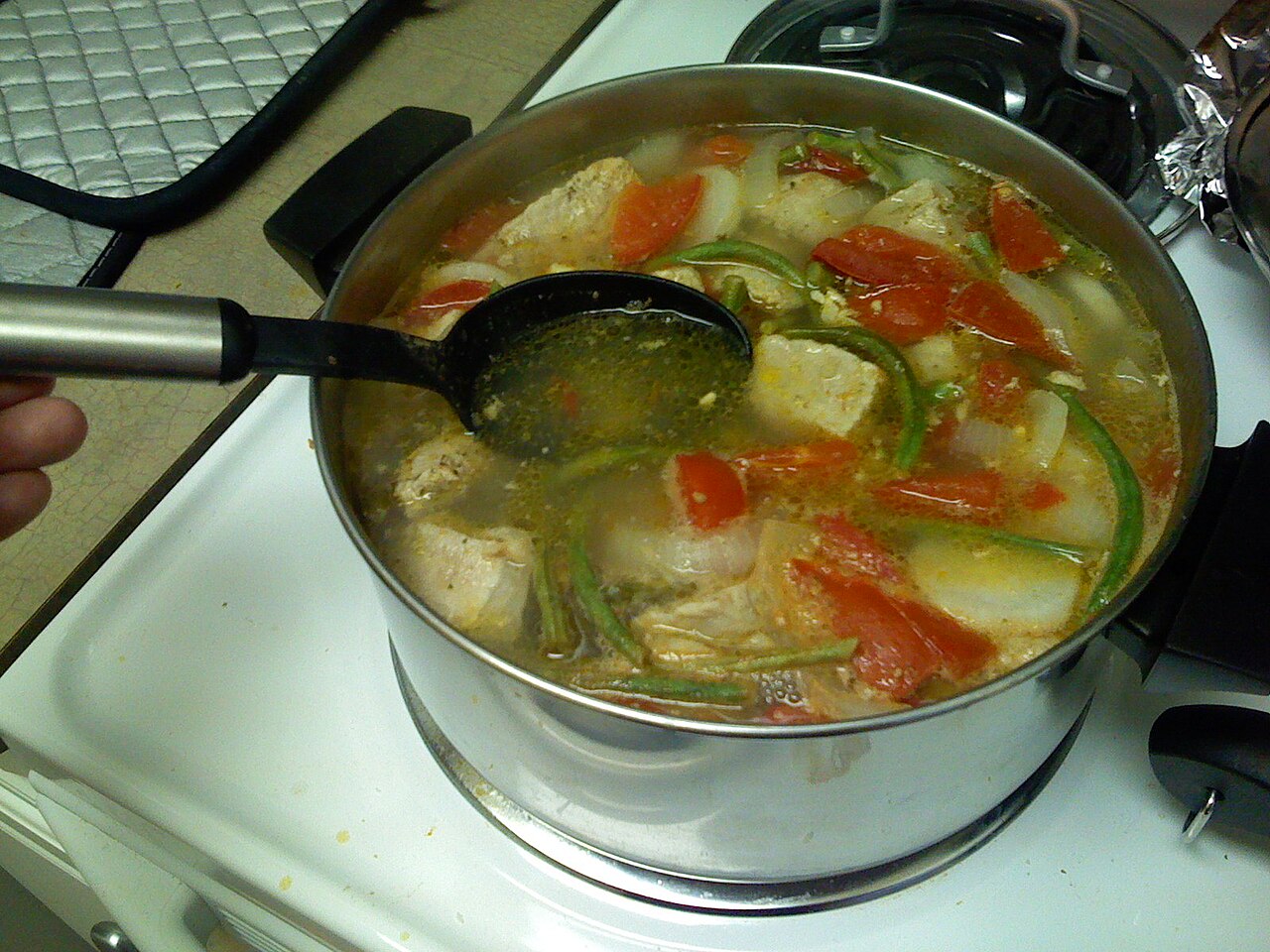
Sinigang is the Philippines' great sour soup, really a whole family of dishes defined by their sharp broth, and sinigang na baboy is the pork version (baboy means pork). The most common souring agent is tamarind, sampalok in Tagalog, and the result is a light, tangy broth full of tender pork and vegetables, eaten with plenty of steamed rice.
This version starts from fresh tamarind pods, simmered and pressed through a sieve, because they give a brighter, fruitier sourness than anything from a jar. The pork simmers first with onion and tomato until tender, then the vegetables follow in stages so each is cooked just right: radish first, then long beans and eggplant, and the greens wilted at the very end.
The usual mistake is timidity. Sinigang should be properly sour, more than you might expect, with the pork and rice there to balance it. Taste before serving and keep adding tamarind until the broth makes you sit up.
Ingredients
Pork and broth
Tamarind
Vegetables and seasoning
To serve
Method
Tap a step's number to tick it off, and a time to start a timer.
Simmer the pork
Put the pork and the 1.5 l water in a large pot and bring to a boil over high heat. As it comes up to the boil, skim off the grey foam for about 5 minutes, until the surface is mostly clear.
Add the onion and tomatoes, lower the heat, partly cover and simmer gently until the pork is tender and starting to pull away from the bone, 1 1/4–1 1/2 hours (about 1 hour for belly).
Make the tamarind juice
While the pork simmers, rinse the tamarind pods; if they're ripe and brown, crack off the brittle shells and pull away the strings first. Put them in a small saucepan with the 500 ml water, cover and simmer over medium heat until the skins split and the flesh is very soft, 15–20 minutes.
Mash the tamarind in its liquid with a fork or potato masher. Push everything through a sieve into a bowl with the back of a spoon, scraping the pulp from the underside, and discard the skins, seeds and fibres.
Add the vegetables
When the pork is tender, stir in the tamarind juice and about two-thirds of the fish sauce and bring back to a simmer. Add the radish and cook until it starts to turn translucent at the edges, 5 minutes.
Add the long beans, eggplant and whole green chillies and simmer until the beans are tender but still bright green and the eggplant is soft, 5–7 minutes.
Taste and adjust: the broth should be distinctly sour and savoury. Add more fish sauce or salt as needed, and if it isn't sour enough, a little tamarind concentrate (see Tips).
Turn off the heat, push the kangkong under the broth and leave it to wilt for 1–2 minutes. Serve straight away with rice, and small dishes of fish sauce with sliced chilli for dipping the pork.
Swaps
Cooking for coeliac disease or an allergy? Check every label: the notes below say which ones matter.
Gluten-free
- Already gluten-free as written, as long as your fish sauce is labelled gluten-free (some contain wheat), both in the pot and in the dipping dish. Check the label on tamarind concentrate too, if you use it.
- Packet sinigang mixes (see Variations) vary by brand: use one labelled gluten-free, or stick to fresh tamarind or plain tamarind pulp.
Plant-based
- Not vegan as written: the pork and fish sauce are its savoury backbone. For a vegetable sinigang, simmer the onion and tomatoes in the 1.5 l water with 3 small taro, peeled and halved, until the taro is tender, about 25 minutes, then carry on from step 5. Add 300 g firm tofu in cubes with the long beans and season with salt, or tamari labelled gluten-free, instead of fish sauce.
- It's a different, lighter soup: bright, sour and good, but without the pork it's a sour vegetable soup rather than sinigang na baboy. Offer salt and sliced chilli for dipping instead of fish sauce.
High-protein
- Prawns as well as pork: add 250 g peeled raw prawns after the beans and eggplant and simmer until pink and opaque all the way through, 2–3 minutes: about 12 g more protein per bowl.
- Tofu: add 300 g firm tofu in 2 cm cubes with the long beans: about 10 g more per bowl.
Tips
- If you can't get fresh tamarind, soak 100 g seedless tamarind pulp (sold in blocks) in 250 ml hot water for 15 minutes, squeeze it with your fingers and sieve, then use the liquid in step 5. Jarred tamarind concentrate varies hugely in strength, so start with 2 tbsp and add more a spoonful at a time. Avoid pods labelled sweet tamarind; they're for snacking.
- Use rice water if you have it. The cloudy water from the first or second rinse of rice (hugas bigas) is a traditional base and gives the broth a little extra body. Plain water works fine.
- Stagger the vegetables. Radish needs the longest, beans and eggplant less, and the greens only the residual heat. Added all at once, the greens turn khaki and the eggplant falls apart.
- Keep the chillies whole. Long green chillies are mild and are there for their fresh, green fragrance. Split one open if you want real heat.
- Substitutes are easy. Green beans stand in for long beans, any long, mild green chilli for siling haba, and spinach for kangkong (water spinach); spinach wilts in seconds, so stir it in just before serving.
Make ahead and storage
- The pork can be simmered a day ahead. Cool the broth quickly, refrigerate it with the pork, lift off the set fat the next day, then reheat and carry on from step 5.
- Leftovers keep for 3 days in the fridge, though the vegetables soften and the greens darken. Bring back to a boil before serving.
Variations
- Shortcut with a packet mix: many Filipino home cooks use a powdered tamarind soup base (sinigang mix) instead of fresh tamarind. Stir it in at step 5 a little at a time, to taste, and season only after, since most mixes are already salted. Check the label if you need it gluten-free.
- Thicker broth with taro: add 3 small taro (gabi), peeled and halved, with the onion and tomatoes. They soften and partly break down, thickening the broth.
- Other versions: for prawns instead of pork (sinigang na hipon), simmer the onion and tomatoes in the water for 15 minutes, carry on from step 5, and add 500 g shell-on prawns after the beans and eggplant, simmering until pink and opaque all the way through, 2–3 minutes, before the greens go in. Ripe guava (sinigang sa bayabas), green mango or bilimbi (kamias) can replace the tamarind, each with its own kind of sourness.
Your notes
Keep your cooking notes private in your account. Save what you changed and what you'd do next time.
Reviews & cooks' tips
Reviews and tips from people who've cooked this appear here.