
United States · Smooth & creamy
New England clam chowder
Fresh clams steamed open for their briny juices, salt pork, soft potatoes and thyme in a milky broth that never boils. Gentle, sweet and tasting of the sea, with oyster crackers.
- Prep
- 30 min
- Cook
- 55 min
- Total
- 1 hr 35 min
- Effort
- Takes some care
- Serves
- 6
The total includes 10 min of soaking, resting or chilling.
Ratings by the Soupmap Culinary Team, not readers.
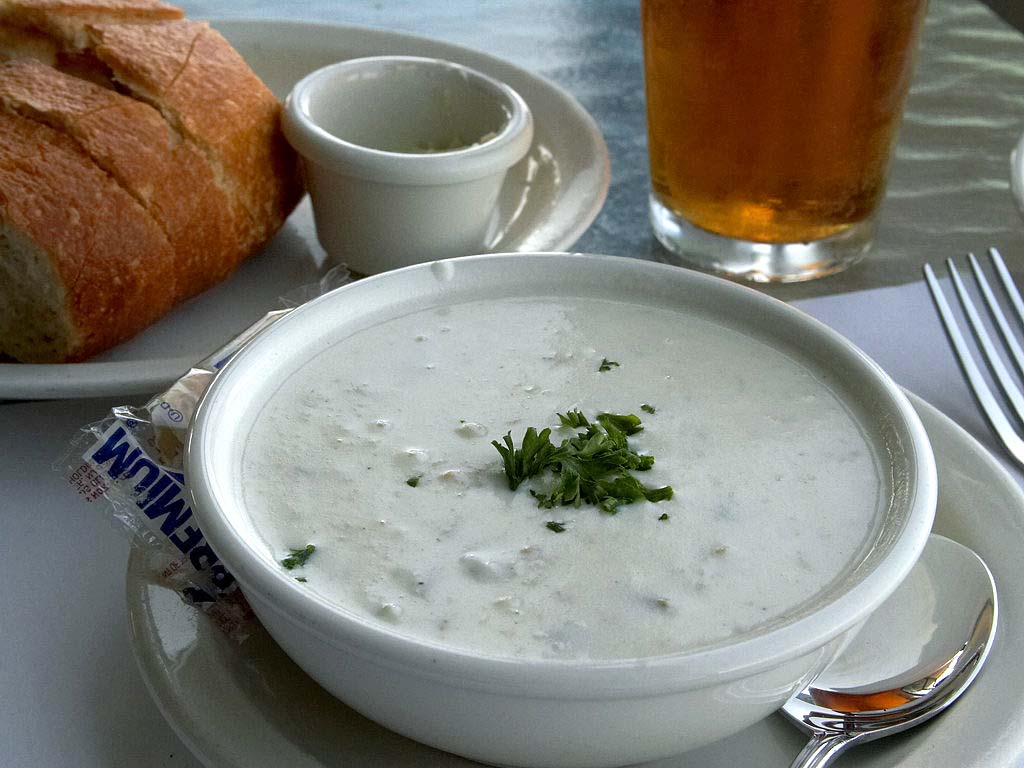
New England clam chowder should taste first of clams: sweet, briny and a little porky from the salt pork, with soft potatoes and just enough milk and cream to make it rich. It's thinner than the thick, floury chowder many restaurants serve, closer to a creamy broth, thickened only by the starch from the potatoes.
What makes this version work is steaming fresh clams yourself. As they open they release their liquor, the briny juice held inside the shell, and that becomes the backbone of the soup. Bottled clam juice is a useful top-up, but fresh liquor tastes brighter and cleaner. The clams come out of the pot the moment they open and go back in only at the end, so they stay tender rather than rubbery.
The one thing people get wrong is boiling it once the dairy is in. Milk in a salty, briny broth can curdle if it bubbles hard, and the chowder turns grainy. Keep it steaming, never bubbling, and it stays smooth. Serve it with oyster crackers, small round salted crackers, for crumbling over the top.
Ingredients
Clams
Chowder
To serve
Method
Tap a step's number to tick it off, and a time to start a timer.
Steam the clams
Check the clams: discard any with cracked or broken shells, and any that are open and don't close when you tap them firmly on the counter. Scrub the rest under cold running water. If they seem sandy, soak them for 20 minutes in cold water salted like the sea (about 35 g salt per litre), then lift them out, leaving the grit behind.
Bring the 500 ml water to a boil in a large pot with a tight-fitting lid over high heat. Add the clams, cover and steam, shaking the pot once or twice. After 5 minutes, start lifting the clams that have opened into a bowl with tongs, and keep going until all that are going to open have, 8–10 minutes in all for small clams and a few minutes more for big ones. Discard any that stay shut.
Let the liquid in the pot settle for 5 minutes, then pour it slowly through a sieve lined with a damp paper towel or cloth into a measuring jug, leaving the last gritty spoonful behind.
When the clams are cool enough to handle, pull them from their shells over the bowl, then strain any juice in the bowl into the jug. Top the liquid up to 1 l with the bottled clam juice, or with water if it already tastes very salty. Chop the clams into 1 cm pieces (small ones can simply be halved), cover and refrigerate.
Make the chowder
Put the salt pork in a heavy pot (4–5 l) over medium-low heat and cook, stirring now and then, until the fat has rendered and the pieces are golden and crisp at the edges, 8–10 minutes.
Add the butter and onion and cook over medium heat, stirring, until the onion is soft and translucent but not browned, 6–8 minutes. Add the thyme and bay leaves.
Add the potatoes and the 1 l clam liquid, with just enough water to cover the potatoes if needed. Bring to a boil over high heat, then turn down to a steady simmer, set the lid ajar and cook until the potatoes are tender all the way through to the point of a knife, 12–15 minutes. Press a few cubes against the side of the pot with a spoon to thicken the broth a little.
Turn the heat to low and stir in the milk and cream. Heat gently, stirring now and then, until the chowder is steaming hot and tiny bubbles appear at the edge of the pot, 5–8 minutes; don't let it boil.
Stir in the chopped clams and warm them through for 1–2 minutes, still without boiling. Fish out the thyme stems and bay leaves. Taste, grind in plenty of black pepper and add salt only if it needs it, because the clam liquor and salt pork are already salty.
Serve
Ladle into warm bowls, scatter with chives or parsley and serve with oyster crackers for crumbling over.
Swaps
Cooking for coeliac disease or an allergy? Check every label: the notes below say which ones matter.
Gluten-free
- The chowder itself is gluten-free: it's thickened only by potato. Serve it with crackers labelled gluten-free instead of oyster crackers, which are made from wheat flour, or with none.
- Check the labels on the bottled clam juice and the salt pork or bacon, and skip the flour in the Thicker chowder variation: mash more of the potato against the pot instead.
Plant-based
- Honestly, this isn't clam chowder any more, but a creamy New England-style corn and potato chowder is worth making. Soften the onion in 3 tbsp olive oil with 1/2 tsp smoked paprika in place of the salt pork and butter.
- For the liquid, use 1 l vegetable stock (check the label: some cubes contain milk) warmed with a 10 cm square of kombu for a hint of the sea, lifting the kombu out before it boils. Replace the milk and cream with 750 ml unsweetened soy milk and keep it below a simmer.
- In place of the clams, add 300 g sweetcorn kernels or torn oyster mushrooms with the potatoes, and check the crackers contain no milk or butter.
High-protein
- Add canned clams: stir 150 g drained canned chopped clams in with the fresh ones at step 9, for about 6 g more protein per bowl.
- Make it a fish and clam chowder: add 300 g skinless cod or haddock, in 3 cm chunks, with the milk and cream, and keep the heat low until it flakes easily, 5–6 minutes. About 9 g more per bowl.
Tips
- Buy clams alive and keep them that way. The shells should be tightly closed, or close when tapped. Keep them in the fridge in an open bowl under a damp cloth, never in fresh water or a sealed bag, which kill them, and cook them within a day.
- Take each clam out the moment it opens. Clams toughen quickly. They're warmed through again at the end, so all they need in the steaming pot is enough heat to open.
- Never boil after the dairy. Keep the heat low once the milk and cream go in. The potato starch helps keep the chowder stable, but a hard boil in salty clam broth can still make it split.
- Use a medium-starch potato. Floury potatoes collapse into mush and very waxy ones stay too firm to thicken anything. Something in between holds its shape while giving up a little starch to the broth.
- Clams outside New England. Any small to medium hard-shell clam works: Manila clams (asari) or hamaguri (larger Japanese hard clams) are excellent. Large quahogs, sold as chowder clams (the biggest size of the same New England clam), are tougher and need chopping finely.
Make ahead and storage
- Chowder is even better after a rest, so it's a good one to make a few hours or a day ahead. Cool it quickly, refrigerate it within 2 hours and eat it within 2 days.
- Reheat it gently over low heat, stirring, until steaming hot all the way through, without letting it boil.
- Don't freeze it: the potatoes turn mealy and the dairy can separate.
Variations
- Canned clams (shortcut): use 300 g drained canned chopped clams. Make up 1 l of liquid with the juice from the cans and bottled clam juice, start at step 5 and stir in the clams at step 9.
- Thicker chowder: stir 2 tbsp plain flour into the fat with the softened onion and cook for 2 minutes before adding the liquid, for a thicker, restaurant-style bowl.
- Lighter: use 750 ml whole milk and no cream.
- Rhode Island-style clear chowder: leave out the milk and cream and make up the volume with more clam liquor or water, for a clear, brothy chowder.
Your notes
Keep your cooking notes private in your account. Save what you changed and what you'd do next time.
Reviews & cooks' tips
Reviews and tips from people who've cooked this appear here.